Sampling the “Secret Sauce” of CIE Tours Success with Managing Director Stephen Cotter

 YouTube

 TuneIn

 Deezer

 Spreaker

 Podcast Addict

 RSS Feed

 Apple Podcasts

 Spotify

 Amazon Music

 Overcast

 Castro

 iHeartRadio

 PocketCasts

 Castbox

 Podchaser
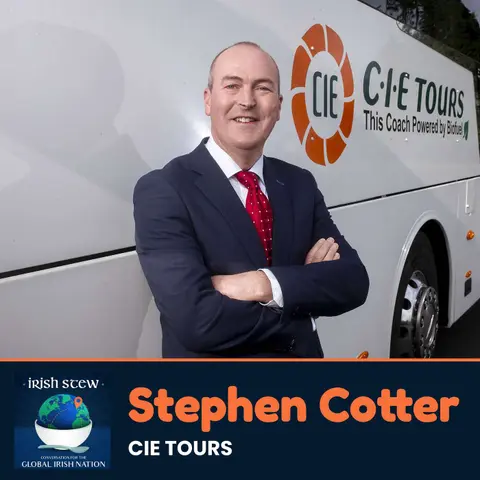
The Today Show spotlighted Irish tourism last week in the U.S., but now it’s Irish Stew’s turn to tell the tale to its global audience through the eyes of Stephen Cotter, managing director of CIE Tours International, a company with over 90 years of history bringing people to experience Ireland and beyond.
With cohost John Lee flying solo this time, the episode explores CIE Tours’ unlikely origins in the International Eucharistic Congress of 1932, the dynamics of its Irish Government ownership, its impressive international scale and reach, why it’s expanded beyond Ireland’s shores, the “secret sauce” that keeps visitors coming back, the off-the-beaten-track experiences it’s offering, Stephen’s photo op with the Taoiseach that made national news, and why the tourism industry has such a hold on him.
"The business just grabs you. There's never a dull moment," he says, reflecting on such non-dull moments like economic downturns and the COVID pandemic. “Every few years, you have something that's going to knock you back. There's always a challenge that keeps it exciting."
In a high-tech world, Stephen cherishes CIE’s high-touch moments. “What I like most about it is when I meet our customers. We’re just so privileged and so honored to work in a business that’s putting a smile on our customers’ faces.”
He knows he has an excellent product to sell in Ireland and all the CIE Tours destinations with a strong slate of tours on offer for each, but to him it’s the guides, not the itineraries, which keeps people coming back to CIE Tours.
“The biggest value on our trips is what the driver and the tour guide add to the experience. That is our ‘secret sauce,’ the crew working in all our destinations--Italy, Iceland Scotland, Spain and in Ireland,” he says. “You would not believe the testimonials that we get back. People just fall in love with the crew.”
The episode explores Stephen’s Dundalk boyhood, his early business experience bidding atBelfast furniture auctions, a marriage proposal involving a lamb in Sligo, and a framed photograph of the Taoiseach's father that turned a three-minute protocol stop into a major media opportunity.
And in a tourism-centric episode, it’s not surprising that the conversation might begin with the Burren, but it’s the bovine slant to the opening that’s unexpected.
"If you'd said to me 10 years ago, I'm going to be talking about cattle, no-fence collars and GPS, I would have said you were mad," he says of a CIE Tours sustainability initiative. The program facilitates cattle-grazing on the Burren’s winter uplands, which suppresses unwanted plant species from taking over and encourages the region's rare flowers to return each spring, which also encourages the return of tourists. Additionally, the relative ease of managing cattle remotely through GPS collars is helping keep young farmers in business bymaking grazing on this marginal land viable.
And what business conversation today doesn’t touch on AI? While embracing AI’s efficiencies, Stephen says, "People like people. Hopefully in my lifetime, that's never replaced by any AI computer or AI bot."
LINKS
CIE TOURS
IRISH STEW LINKS
- Website Home Page
- BlueSky
- Mastodon
- Media Partner: IrishCentral
Episode Details: Season 8, Episode 28; Total Episode Count: 169
00:00 - Introduction
01:30 - Cattle Collars in the Burren
06:39 - How CIE Tours Began
09:38 - A Government-Owned Operator
11:08 - Beyond Ireland's Shores
13:19 - Hiking and New Products
17:21 - From Dundalk to Managing Director
19:34 - Why Tourism Grabs You
21:43 - The CIE Tours Secret Sauce: The Guides
26:45 - Off the Beaten Track
32:21 - A Photo for the Taoiseach
36:17 - People Like People
37:46 - The Seamus Plug
39:45 - John's Episode Recap
40:25 - Credits
Sampling the “Secret Sauce” of CIE Tours Success with Managing Director Stephen Cotter
Episode transcript · Released October 19, 2026
This transcript was generated by AI speech-to-text and given a light editorial pass to remove filler words, false starts and repeated words. Names, places and organizations were reviewed and confirmed by the Irish Stew production team. The episode itself is the authoritative record.
Speakers: John Lee Stephen Cotter Martin Nutty
Jump to chapter
# TIME CHAPTER
1 0:00 Introduction
2 1:30 Cattle Collars in the Burren
3 6:22 How CIE Tours Began
4 9:38 A Government-Owned Operator
5 11:08 Beyond Ireland's Shores
6 13:19 Hiking and New Products
7 17:21 From Dundalk to Managing Director
8 19:34 Why Tourism Grabs You
9 21:43 The Guides' Secret Sauce
10 26:45 Off the Beaten Track
11 32:21 A Photo for the Taoiseach
12 36:17 People Like People
13 37:46 The Seamus Plug
14 39:45 John's Episode Recap
15 40:25 Credits
0:00 Introduction
Martin Nutty [0:00]
Before we begin, a quick request. If you'd like to keep up with Irish Stew between episodes, sign up for our newsletter. You'll find it on the home page at IrishStewPodcast.com.
John Lee [0:14]
And stay with us to the end of the episode, because we have an invitation for you to be part of an upcoming show.
Stephen Cotter [0:23]
That sort of sums up Ireland. Here's the leader of the country, and you meet him once, and all of a sudden you identify the one little connection, and a few years down the line, that connection surfaces back up again, and you can use it in a positive way. And if you tell people in America, where it's so vast, they just can't get their head around how you could have a connection like that. So I think that's what's wonderful about Ireland.
John Lee [0:47]
That's Stephen Cotter, Managing Director of CIE Tours International, with over 90 years of history bringing people to experience Ireland and beyond. I'm John Lee, flying solo in this episode, where we'll explore the unusual origins of CIE Tours, its impressive scale and reach, why it's expanding beyond Ireland's shores, its secret sauce, the off-the-beaten-track experiences it's offering, Stephen's photo with the Taoiseach that made national news, and why the tourism industry has such a hold on Stephen Cotter. Let's get to it.
1:30 Cattle Collars in the Burren
John Lee [1:30]
Stephen, we're going to start with GPS. Now, GPS is a great thing for tourists. It helps them on their phone to navigate around a new country. But we're going to talk about solar-powered GPS collars that are worn by cattle. What does that have to do with tourism and CIE Tours?
Stephen Cotter [1:50]
Yeah, it's as surprising for you as it is for me. If you'd said to me 10 years ago, I'm going to be talking about no-fence collars and GPS for cattle, I would have said you were mad. That's not what I'm into, but here I am.
So the story behind that is, as part of our Sustainability Action Fund, we ring-fenced some money where we wanted to support different projects in the communities where we're operating our tours, projects of a sustainable nature. One of the really excellent ones is over in the Burren. It's Project ReFarm, and it's through the Burrenbeo Trust, who are a group of farmers in that area who are looking at sustainable ways to protect their livelihood and the landscape and make it enjoyable for people into the future, which is what we want too. Nearly all of our customers are driving through the Burren. They're going to see the Cliffs of Moher. It's unique in Ireland. You get flowers growing in the Burren that you don't get growing anywhere else around Ireland, and it's important that that's protected.
So the story around the no-fence collars is that the farmers who farm that land, in the wintertime they send their cows up into the mountain. In October, it's called a winterage. There's all this lush grass for the cows to eat over the winter, and by the cows eating all this grass, it allows the sun, when the spring comes, to get into the soil and for these flowers to grow up. If the cows don't eat the grass, then it gets overgrown, the sun doesn't get in and the flowers don't grow.
So the no-fence collars are designed to help the farmers, because the landscape is so rugged and barren, they don't have fences up there to keep the cows under control, so the cows can wander off and get lost. The collar slips over the cow's neck, and the cow is trained for about four or five weeks beforehand before it's let loose with the collar. There's a virtual field that the farmer has on an app on his phone, and he's able to draw this virtual field. It could be a couple of hundred meters by a couple of hundred meters. And as the cow is eating the grass and wandering towards the edge of that boundary, music starts to come on. The cow is trained to know that when he hears that music, he's getting near the edge. If he keeps going, he'll get a short little shock like you would get from an electric fence. It's not painful, it's just a little jab. So he turns around and goes the other way.
So you can only picture this on the side of the windy Burren mountain in January, a cow roaming along and this music comes on. You can hear the music when you're standing next to the cow. People always ask me what type of music it is. I'm not sure if it's classical or heavy metal or rock.
But anyway, big picture, this makes such a difference. I've met these farmers, young farmers, 25, 30-year-old farmers, third, fourth generation. They're passionate about their land. They're passionate about this area. It's a tough, tough business, and they don't make enough money out of farming to sustain them full-time, so they have to have a second job. So this really helps them that they're not coming home in the evening and two or three cows are lost and they have to spend four or five hours up looking for them. They know where the cows are, so it's made their life easier. And if they don't use this technology to make their lives easier, you run the risk of them deciding, "This is too difficult. I'm not going to do this anymore. I'm going to move to Dublin. I'm going to get a job somewhere else." And then the land isn't going to be kept, and 20 years down the line, we're all going to wonder, where have those beautiful flowers gone that used to be here?
John Lee [5:27]
And the tourists are not going to want to be looking at that area.
Stephen Cotter [5:31]
It's just not as beautiful as it can be. And people get huge pleasure out of it, but we can't take it for granted for a second. So that's something small that we're doing. With the money that we gave them last year, they bought over a hundred of these collars. I went over to see them in action. The farmers are thrilled with them. And it's good for the engagement that our company, CIE Tours, has with the community, because there can be negativity in the Burren, in that area, around over-tourism and around the Cliffs of Moher. There's so much traffic going through. But all the farmers who've benefited from this, I know that when they see our coaches going past with the CIE Tours colors, they're thinking very positively about our company. That's not the reason why we're doing it, but I know that that's what's happening, and that's good for everybody. There's five or six other initiatives that we're doing, but that's a particularly nice one that I like to tell people about.
6:22 How CIE Tours Began
John Lee [6:22]
Sometimes sustainability efforts have that sort of greenwashing effect. But here's one that works on many levels. It impacts your business to a certain extent. It preserves rural lifestyles. It allows farming to stay, and it preserves the Burren. So, one of those win-win-win situations.
We talked about CIE Tours. Let's get into what it is exactly. We're here in Ireland House, up on the 17th floor looking out over Park Avenue. It's the home of Ireland's Consulate in New York, Tourism Ireland, Enterprise Ireland, Bord Bia, IDA Ireland, and now we're in your office here at CIE Tours. I know CIE is Irish words. I'm not too good with my Irish.
Stephen Cotter [7:02]
Of course, Córas Iompair Éireann, and we're owned by the Irish government. We were founded back in 1932, so 94 years this year. We're looking forward to our 100th anniversary in 2032. The reason the company was started up back in 1932, the Eucharistic Congress was happening in Dublin. It was a huge movement of people coming from all over the world for a big religious festival. And the government decided that they needed a company set up to manage the logistics, the accommodation, the transportation for all these groups of people. So they set up CIE Tours, or what became CIE Tours.
John Lee [7:41]
So in 1932, there hadn't been much of a tourism infrastructure.
Stephen Cotter [7:45]
No, no. The state was just getting developed. I think at the time there were people staying in boats and things like that, or big ships along the quays. But the Congress went really well, and it was a big success for the CIE Tours involvement. And the government decided after that, why don't we just keep this company here and maybe we can use it to promote and develop tourism around Ireland? Mainly domestic, mainly Irish people, maybe people from the UK initially coming over. It was really successful with the rail network and the network of Great Southern hotels with the trains. It all worked very well, and it was all closely connected to those companies.
And then when air travel across the Atlantic and jet travel became popular in the '50s and into the '60s, our focus really shifted internationally. Now we predominantly focus on the American market. We bring about 35,000 people a year across the Atlantic. Most of those people travel to Ireland. Some go to other destinations that we have. We're really proud of the reputation that we've built in America, that we're a market leader. We bring the most people on coach tours into Ireland from America. We do it really well. We have a really good reputation, really high quality.
We've got an office in Morristown, New Jersey, where we have most of our U.S. staff. We have this small office here in Ireland House. We're part of the Irish government, so it's nice to be included with all the agencies here. And then we've 40 people working in our Dublin office and a few people in the U.K. So we've 130 people across three different locations. And I always say to them, it's incredible what we do with 130 people, because moving 35,000 people from one continent to another, meeting them at the airport, making sure everything is coordinated, everything's booked ahead of time, everything goes to plan, and they have a great time on top of that, there's a lot of work that goes into that. So I'm really proud of all the team that we have and how they do it.
9:38 A Government-Owned Operator
John Lee [9:38]
Being a government organization, that's a different setup for a tourism operator. What's the advantage there?
Stephen Cotter [9:45]
One advantage is security. We're a very secure company. When it comes to our suppliers, for example, they're not worried about getting paid. We're always going to pay them. We have to pay them, and we have to pay them within 30 days. So there's rules like that that really benefit our suppliers and the relationship we have with our suppliers. The security, again, during COVID: we were shut down for a year and a half during COVID, and we got support from the CIE group. Now, we had given them all our profits over the years, and we got that support there. So that was important, to know that they valued us as a company and they wanted us to be part of the recovery after COVID.
One of the big things, I think, from the CIE group perspective: most people would be familiar with the CIE group. It's public transport in Ireland, the buses and the trains around Dublin and all around the country. There's nothing too sexy about public transport. You're under pressure all the time around punctuality and frequency. So I think CIE Tours is a good example that the CIE group can show that when they're given the opportunity to compete in the most competitive market in the world, and America is the most competitive market in the world, to set up a company to compete in America and be a market leader into Ireland, they can do it. And they can do it profitably and do it over a long period of time. So when given the opportunity, the government can do those things.
11:08 Beyond Ireland's Shores
John Lee [11:08]
But I imagine there's a different set of priorities, what you're trying to do for the country, not just for the company.
Stephen Cotter [11:15]
Yeah. Well, I mean, our remit really is to make money. Our remit isn't to bring people into the country. It sort of is indirectly; that's what we do. But it's not written down anywhere that we've been set up to bring people into the country. So we're now bringing people from America to other destinations. We're bringing them to Italy, we're bringing them to Iceland. We started that in 2019. And now we're bringing people to Spain. We started that last year. So there's other destinations, and we're making money from doing that.
We're trying to increase our repeat customers. A lot of customers will come to Ireland, or they might go to Scotland with us. Traditionally, only maybe 10% of those people would come back on a coach tour to Ireland. Once they've done it, they tick the box. They want to go to a different...
John Lee [11:59]
Starter tour.
Stephen Cotter [12:00]
Yeah, and they might have the confidence then to come back and do it themselves or do a fly-drive. We only would get about 10% repeat business historically, so that's why we started offering these new destinations. Italy and Iceland were first, in 2019, just before COVID, unfortunately. But after COVID, they recovered well. And then last year, Spain. We have another new itinerary coming for Spain for next year. It's going to be northern Spain into Portugal.
The great thing about those new destinations, we know from our systems that we get about 40% repeat business. So somebody's come to Ireland, had a great time, doesn't want to go back to Ireland again. Where else do you go? "Well, we go to Italy. Would you like to go to Italy?" "Absolutely." And we do it as well in Italy as we do it in Ireland. We make sure that the quality is consistent and the delivery and the standards are consistent. So 40% of the people in Italy and Iceland and Spain have been with us before. But the flip side of that is 60% of the people on those buses are with us for the first time. And if we do a good job in Italy or Spain, which I know we are doing, they're really confident then to say, "Oh, let's go to Ireland next time."
So it's a good system that we've developed. We don't want it to get too big. We don't want to be global or anything like that. We want it to be manageable and to be niche, for it to make sense. And so far, so good. It's working out very well.
13:19 Hiking and New Products
John Lee [13:19]
Stephen, I noticed a word you use a lot is product. What's new and different and coming up that you're going to be offering people, or already offering, that's new in your product line?
Stephen Cotter [13:28]
There's different travel types and travel styles, I suppose. Again, our large coach tour, it's a great experience when people do it. Some people can be put off by it until they try it. But once they try it, they realize it's so relaxing. You're taken by the hand by your tour guide. You don't have to think. We're not selling you options. You go on a cruise or you go with some other companies and there's an optional extra that night, and you have to decide if you want to do it or not. We include everything in our tours, so you don't have to think about those things. You can completely relax.
But I think the thing that surprises people most is the interaction they have with their fellow passengers. The tour guide does a great job with this, gets people introduced at the beginning. People might feel a bit uncomfortable about that, but over time they're having breakfast or lunch, and they're sitting at tables, and they're chopping and changing. And by the end of the tour, they're all friends. They're all friends on Facebook, they're sharing photographs. It's like a whole new group of people. So that's our main thing. That's not for everybody, so we have our Chauffeur Drive, which is smaller groups with an individual driver.
But something new that we started selling last year and started operating this [year], and we're really excited about this, is hill walking and hiking. It's a new travel type, and it's really popular at the moment. Over the last number of years, it's getting a lot of traction. It isn't the same volume that we would have on our large coaches, so they're smaller groups, eight up to a maximum of 16 people. And we have two beautiful itineraries at the moment. One is from Glengarriff in Cork over to Dingle, so the Cork and Kerry mountains, over seven nights. The second itinerary is from Slieve League in Donegal across the northern coast to the Giant's Causeway.
We're really happy with the feedback we've got from our customers. A lot of people who've done the northern one so far have written to us saying how amazing it was, how the tour guide was amazing, the accommodations were amazing, the scenery was amazing. And they've already booked to do the southern Ireland one for next year, which is music to my ears. If that continues going well in Ireland, we might introduce a few more itineraries, and then Scotland is the next obvious destination for hill walking and hiking. We can switch it on very easily over in Scotland. We do an awful lot of business to Scotland as well. We're the biggest into Ireland, and we're the biggest into Scotland from the US in terms of escorted coach tours. We bring about 12,000 or 13,000 people a year into Scotland.
John Lee [16:01]
The Scotland brand is pretty hot right now, coming out of the World Cup.
Stephen Cotter [16:04]
Yeah, absolutely. Well, look, they made it, which is good for them. They probably would have liked it done a little bit better. But Scotland, again, the product is amazing. The scenery is amazing. The people are amazing. The experience people have, they absolutely love it. So we're popular in Scotland.
We're always looking at other things. Golf is something that's really, really popular in Ireland and Scotland. There are golf operators that specialize in that, and we sort of stick in our lane, really, and they do that very well. But I'm always thinking about how we could leverage the distribution network that we have in the U.S. through the travel trade. Maybe there's a wasted opportunity for us there with golf. River cruising, again, is something in Europe that's really, really popular. It's expensive, but there's big demand for it. It might be a few years down the line, but we're doing some numbers on that at the moment, just to see, is that something else that our customers would like us to do?
So look, we're never going to drift too far away from our core business, which is large escorted tours around Ireland, and that's what we're really, really good at. We never take our eye off that ball. We try and do other things as we move along, but our core product is always going to be our core product, and we're very proud that we do a good job on that.
17:21 From Dundalk to Managing Director
John Lee [17:21]
What was your experience that led you towards this line of work?
Stephen Cotter [17:25]
I'm originally from Dundalk, County Louth, from the Wee County. We just had our most successful year in 70 years, getting to the semifinal of the All-Ireland. So that was definitely the highlight of the year so far. I'm one of six kids, and my parents are still alive, thankfully, living in Dundalk. I'm the second youngest. My dad had a haulage business that went out of business in the late '70s, early '80s. And then they started up a small secondhand furniture business. They used to go to Belfast, up in the north of Ireland, every week to auction rooms to get their stock for the shop.
So when I was very young, when I was 10, 11, 12, 13, I used to work in the shop, and I used to go to the auctions with my parents. And my mum started me off with a small allowance of 20 euros, or 20 pounds, and I would buy a few items, and we'd bring them back and see if my dad could sell them in the shop. So at a very, very young age, I really got a feel for being commercial, what it meant to buy something and create a bit of value and be able to sell it. That was really the foundation that I got at that time. We didn't have a lot of money, so you had to do what you had to do. And I got a real buzz out of doing that. I got a buzz out of buying. I got a buzz out of identifying something that I knew I could buy at a certain price and sell at a higher price.
John Lee [18:47]
Did you get to keep the profits?
Stephen Cotter [18:49]
Absolutely, yeah. That was my pocket money. So that was a good foundation. I went to college in Dundalk, I went to Australia for a couple of years, and then I landed back in Ireland just when the Celtic Tiger was in full flow, back in 1999. And shortly after that I started working for CIE Tours.
John Lee [19:07]
You had an accounting background.
Stephen Cotter [19:09]
Yeah, I'm a CIMA-qualified accountant. I did those exams in the '90s. Finance was my first role in CIE Tours. I started off in finance, became the financial controller, then the general manager of Ireland, and then a couple of years ago I was appointed managing director and CEO over the company. Tourism, it grabs you. The business just grabs you. It's such an exciting business.
19:34 Why Tourism Grabs You
John Lee [19:34]
What grabs you?
Stephen Cotter [19:37]
Well, there's a few different things. There's never a dull moment. There's always some sort of challenge. The day I started was the 5th of March, 2001. That was the day foot-and-mouth disease was declared in Ireland, and everybody in the company was panicking over this. I just arrived in on my first day, and I didn't make the connection: what has this got to do with tourism? But I learned pretty quickly that it obviously had a negative effect. You had 9/11, unfortunately, later on that year, then you had the wars in Afghanistan. So every few years, you have something that's going to knock you back. There's always a challenge, which is good. That keeps it exciting.
What I like most about it is when I meet our customers. We're just so privileged and so honored to work in a business that's putting a smile on our customers' faces. Our customers really value it. They really love it. It's something maybe they're saving up for a long time. It's a big deal, and we do such a good job at delivering it. They meet our drivers and guides, and they have great fun with them. They make great friends with everybody else on the coach tour. And I meet them regularly at the airport. I see the CIE Tours bag they would have over their backpack, and I never hesitate in tapping them on the shoulder and telling them who I am and asking them how they got on, because I know that they had an amazing time.
John Lee [20:46]
What's their reaction when you say that?
Stephen Cotter [20:47]
They just love it. They absolutely love it, and they want to come back again. They want to go on other destinations.
John Lee [20:51]
Just the fact that you're tapping them on the shoulder and you identify who you are.
Stephen Cotter [20:55]
Well, I think that's what's nice about the company. We're like a family, really. I know it's a bit corny to say that, but we are like a family. There's nobody precious, and everybody has to roll their sleeves up, and you have to roll your sleeves up. You can do that when you know your product is amazing and your quality is amazing. You don't hesitate in talking to your customers. If you know it isn't, then you might be a bit wary. But that's the lovely thing about tourism: you're in an industry that's making people happy. A lot of people are in other jobs where you just don't get that direct feeling, and that's what I like about it. That's what's kept me in the business for 25 years, and a lot of my colleagues have been around for longer. So yeah, it definitely grabs you, and I couldn't see myself doing anything else.
21:43 The Guides' Secret Sauce
John Lee [21:43]
Bringing people to Ireland kind of connects into the mission here in Ireland House, I think, in a lot of ways. We talk about diaspora a lot. There's a term called affinity diaspora, which is all the people who get, let's just use Ireland as the case, an interest, a love, a passion for Ireland, and they may not have any Irish DNA, whatever that is, or any other strong Irish connections, but they've been there. They played golf there. They went to a festival there. They worked there for a while. Or they came on CIE Tours for the first time. So you're a component of kind of like Brand Ireland, I think.
Stephen Cotter [22:22]
You know, it is a beautiful country. In Ireland we've had amazing weather for the last six weeks. We're naturally inquisitive, I think, and we're naturally welcoming to visitors, and we sort of take it for granted. It's only maybe when you go to other countries that you see that's not there. So people like that céad míle fáilte. They like the welcome. The quality is good. The quality of the hotels is good. The food is good. It's expensive-ish, but it's not overly expensive compared to some places in America.
John Lee [22:47]
And I imagine there's cost savings in the fact that you are packaging these things and you're getting...
Stephen Cotter [22:53]
Yeah, we're bulk buying, so we're getting a good deal from our suppliers. When we package all that together, we're creating that value. But the biggest value on our trips is the value that the driver and the tour guide add to the experience. We can do all the work in the background. We work two years in advance. We're contracting with the hotels. We're designing the tours. We're putting all the packages together. We're selling them through the travel trade here, taking the bookings. When the people arrive at the airport, they're handed over to the tour guide and the driver, and they're in their hands for the next 10 days.
And you would not believe the testimonials that we get back. People just fall in love with the crew, male, female. They just have this knack, and it's not easy. Not everybody can deal with 40 people. People maybe have some mobility issues or challenges. Something happens along the way that sets people back that they have to react to. But then they're storytellers, they're comedians, they're singers. It's like they're on stage, and they're performing every week, and then they've a fresh group the following week. And at the same point in the road between Tralee and Kerry, they're telling the exact same joke that they probably told last week, and they're getting the same reaction, because they know it works, and the people just fall in love with them. That is our secret sauce, if you like: the crew that we have, working in all our destinations, in Italy and Iceland and Scotland and Spain and in Ireland. They do such an excellent job. Not everybody can do that. You have to juggle a lot of balls, and you have to stay calm, and then you have to be entertaining.
There's a great story that I came across and shared at one of our driver guide meetings. We have a big meeting at the beginning of the year in the Ashling Hotel to kick off the year. In Ireland we'd have 120 or 130 guides there. A few years back, there was a pub group from Cleveland. There were 40 people in the group, and they went on the tour, and they had an amazing time, and they sent us a montage of photographs and videos just to thank us for the trip. Somebody sent this on to me, and on Monday morning I clicked on it. I saw it was 15 minutes long, and I thought, okay, I'm not going to look at all this, I'll just look at some of it. It was so good, I ended up looking at all 15 minutes.
There was one video piece of about two minutes in the middle of it. The tour guide was driving the coach after leaving Killarney, driving past Tralee, and somebody was recording him from behind. He's a character, this guy. He wears a cowboy hat. And he was telling them the story about the Rose of Tralee, the history and the song and the festival that's held every year. And as he's driving the bus, he starts singing "The Rose of Tralee." He sang the song for two and a half minutes. You could hear a pin drop. Huge round of applause as he's driving the bus.
So I took this video, and when we had our driver guide meeting, I got the guys to put it up on the screen. I said, "I'm going to embarrass somebody here, but I think it's worthwhile doing." They all laughed at it, and they got a good kick out of it. But the point I made was, half an hour before that, he was leaving the Plaza Hotel in Killarney. He was after pulling around the coach, making sure it was clean, making sure there was enough fuel in it. He was after counting all the luggage bags in. He was after counting all the people in. You don't want to leave any of the people behind. He was after going into the hotel to sign the docket on his device to make sure all the accounts were right. He navigates his way out of the busy town at 8:30 in the morning, and he starts on his journey, and he's driving on these small roads. There's not a lot of people who can do all those things and drive this big bus on top of that and be charming and be funny. It's an unusual set of skills to put together. So it is unique what they do, and we wouldn't be as successful as we are without them.
26:45 Off the Beaten Track
John Lee [26:45]
Well, you tap into a theme that always comes up, the Irish storytelling skill. I know a good tour guide can add so much to the experience. What are people looking for now that maybe they weren't looking for 10 years ago, and how are you providing it?
Stephen Cotter [26:59]
People are always looking for experiences. If they can get a unique experience, that's even better. If they can go back home and brag about it, "I did something that you didn't do," type of thing. So we're always on the lookout for things that might be off the beaten track a little bit. People want to go to the Giant's Causeway, they want to go to the Cliffs of Moher, they want to go to the Guinness Storehouse, they want to kiss the Blarney Stone. So you have those iconic things that you want to include on your itinerary, but then you try and weave in other things. For example, something that we weaved in, and again, this is part of sustainability that we're focused on: are there visitor attractions or things that we can do out there that are of a sustainable nature?
We were sort of doing this 20 years ago, before sustainability became a thing. The example I want to give is sheepdog trials. We were the first company offering sheepdog trials. Brendan Ferris was the farmer down at the Ring of Kerry, and we decided to feature this on one of the tours. It got such positive feedback. We know from our quality system, people rated this like 100%. They absolutely loved it. So now on nearly all of our itineraries, you'll see a sheepdog trial. Now there's six or seven companies all along the Wild Atlantic Way offering sheepdog trials. These are farmers that have decided, "I'm a sheep farmer, I have the dogs, I'm going to invest a bit of money." Fáilte Ireland are fantastic. They might help them build a space where they can do this, and then they have another income to supplement their farming. So it's a win-win for everybody. People love animals.
And there's a beautiful story that happened at Atlantic Sheepdogs. It's a beautiful place. Trish and Martin Feeney are the owners, and it's up in Grange, in North Sligo. Beautiful backdrop. And funny enough, it's the same tour guide who was singing the song, Brian Hanrahan. One of his customers came to him at the start of the tour and said, "I want to propose to my girlfriend while we're on the tour. Where would be a good place to do it?" So Brian set this up. This was in the springtime. This will bring a tear to your eye. They went to Atlantic Sheepdogs in Grange, in Sligo, for a sheepdog trial. They had all these new lambs, because it was the springtime. That's a lovely time to go. There was one particular lamb, and the farmer handed it to the soon-to-be fiancée. Around the lamb's neck was a little string with a little pouch, and the farmer said, "Open the pouch and see what's in that pouch." And that was the engagement ring.
So sheepdog trials are something people love, and it ticks the sustainability box. We're doing another super thing up in the north of Ireland. Long Meadow Cider is a company we started working with a few years back, in Lurgan, between Lurgan and Portadown. It's a cider farm where they have a big orchard, and they make cider and other products, and they've set up a tourism side of their business. We go up there, and they get a tour of the production facility and a tour around the orchard. They've built this beautiful glass room right in the middle of the orchard where they have lunch, a soup and sandwich sort of lunch, finished off, of course, with a beautiful, fresh apple tart that they've made, and cream. It rates so highly, like 97, 98% on customer satisfaction. People love meeting a family business. They love being out in the fresh air. So we're always looking for different things like that to put into our tours alongside the standard things that people want.
We also have another part of our business, which is our private driver, Chauffeur Drive. That's for two people or four people or six people, up to a maximum of nine traveling together, and they have their own private vehicle and their own private chauffeur driver. A little bit more expensive, maybe not as much more expensive as some people might think. When they get a quote from us, they might be surprised that it isn't as expensive. But it gives them a bit more flexibility to go off the beaten track, and a bit of flexibility with the driver. The itinerary doesn't have to be so rigid. They can decide to do other things as they're moving along. So yeah, we're always trying to get that mix right.
John Lee [31:08]
My podcast partner, Martin, who couldn't be here today, and I took a tour last year in the Irish Midlands, which we called Off the Beaten Craic. I kind of termed it as, this probably isn't your first trip to Ireland. But we saw terrific things, and we wandered into things, and we went to attractions that I think would rival any similar attraction in Ireland. They just weren't quite in the center of the tourism action.
Stephen Cotter [31:37]
Yeah, I mean, it depends what you're looking for. The places I mentioned can be very busy at different times of year. There's more in these places. So there is something nicer, if you're back there for a second time, about going somewhere where maybe it's less busy. The product is very good. The investment from Fáilte Ireland and the support that they've put into these local regions, trying to get these businesses up and running, supporting them in their marketing and their promotion. They're using great technology, I think, when you go into these businesses. They're advanced. And then the food quality, I think, is great. When you're driving along, you stop off in a pub, and you pay 20 euros for fish and chips, and it's really good quality.
John Lee [32:15]
That's certainly an aspect of Irish travel that has improved so much.
Stephen Cotter [32:19]
Yeah, yeah.
32:21 A Photo for the Taoiseach
John Lee [32:21]
You started to tell me a story about the opening of Ireland House. The Taoiseach was here, Micheál Martin, to open it. Tell us a little bit about what you had prepared for him.
Stephen Cotter [32:33]
That was a couple of years ago. It was September, two years ago. We've a small one-person office here in Ireland House that we've always had, and we're delighted to have it. When I heard that the Taoiseach was coming over to do the opening, I was going to come anyway myself. But I'd met him a couple of years beforehand, and he was telling me that his dad worked... I knew his dad drove buses and worked for CIE down in Cork, but he told me that his dad worked taking American tourists out around Ireland during the summer. So when he told me that, I said, "Well, that must have been us. That must have been CIE Tours." And he said, "Well, I suppose it was."
So I hadn't forgotten that. And when I knew he was going to be over here, I rang Mary Rose, who's his secretary in Cork, and I said, "Mary, would you be able to get your hands on any photographs of the Taoiseach's dad? Paddy Martin, is his name. Would there be any photographs of him standing beside one of our buses, back in the '60s or '70s, when he was working with us, or in a uniform?" So she got to work, and she rang me back a while later. Through Micheál's sister, she identified two photographs. She sent me copies of them, and I was able to get them blown up in a photograph shop and mounted in a frame with a nice little caption on the bottom: Paddy Martin, CIE Tours.
So when we came over here to New York, the Taoiseach was going around all the various entities in Ireland House just for a meet and greet. And it was very strict. The protocol was three minutes in each entity, and then they were going in for a main presentation. We were last on that route before they were going to cut the ribbon. The Taoiseach came into our office. I was here with some of my colleagues, and the first thing he said was, "My dad used to work for CIE Tours." And I said, "It's funny you mention that. I remembered that from a few years ago when we met, and I have a little surprise here for you that I was going to give you when you were leaving, but since you brought it up, we might as well do it now." So I reached behind my desk, took out this picture frame and presented it to him. And his face lit up. He was absolutely delighted with it. He hadn't seen this photograph before.
And we were here for about 10 minutes reminiscing about different stories that he had, his memories of his dad doing that work. I don't know how well it went down with his handlers, who were outside the room. I could see them out of the corner of my eye, looking in, wondering, "What the hell is that picture?"
John Lee [34:55]
It's supposed to be two minutes.
Stephen Cotter [~34:57]
So I thought it was a nice tribute. And I think that sort of sums up Ireland. Here's the leader of the country, and you meet him once, and all of a sudden you identify the one little connection, and a few years down the line, that connection surfaces back up again, and you can use it in a positive way. And if you tell people in America, where it's so vast, they just can't get their head around how you could have a connection like that. So I think that's what's wonderful about Ireland, that we do have those connections.
John Lee [35:29]
And I know that photo made it to national media as well.
Stephen Cotter [35:34]
Well, actually, after we presented the photograph, I said to him, "Look, I'll bring the photograph back and I'll send it over to your office in Dublin." I was heading back that night. And we went next door into the main event room, and they were cutting the ribbon, and there were some speeches. RTÉ were there, and the media were there for the official opening. When that was done, the Taoiseach turned around and caught my eye, and he said, "Will you go and get the photograph again?" So I went and got the photograph and gave it to him, and he was very proudly showing it to all the media and to the RTÉ news crew that were there, and he was telling them all the stories. So you could see there's a lot of pride there with him. I know he's talked very fondly about his dad before. Anyway, that's a lovely connection, I think.
36:17 People Like People
John Lee [36:17]
Perfect word there, human connection. Human connection. We're in a world of being buried in AI and not knowing what's real and unreal. What can tourism and CIE Tours do to re-establish those human connections?
Stephen Cotter [36:36]
At the end of the day, the product that we have, people like people. You're sitting here today facing me. People like interacting with human beings. Even if we were doing this over Zoom, it wouldn't feel as good. People like the casualness with how conversations come up and how you drift into different topics. You can't replace that with a machine. I was at a group meeting a few weeks back, and one of the people in our group asked that question about technology: when you're on a coach and you're passing a landmark, would the audio come on to tell you about that, AI generated? Hopefully that never happens. It's much better when a tour guide is able to tell you a story about it. So efficiencies are great up to a certain point, but then you need human interaction. And we're a curious country, Ireland. We like to welcome people in. We like to ask them questions. We're nosy. So you never want to take that away. That's what people like about us. That's why people like coming to Ireland, that they get that feeling. Hopefully in my lifetime, that's never replaced by any AI computer or AI bot.
37:46 The Seamus Plug
John Lee [37:46]
Well, Stephen, I really appreciate you fitting me into your schedule here. So let's give you something back for the experience, the Seamus Plug. What would you like our listeners to know more about?
Stephen Cotter [37:56]
Well, I suppose this podcast is aimed at the diaspora. And really, in terms of travel to Ireland, the diaspora are not our typical customer, because if the diaspora know Ireland, their friends and family are there. If they're going back home, they don't need us to take them around. Now, that's not to say that some of the diaspora wouldn't go on our tours in Ireland, but in general, that wouldn't be the market that we're trying to appeal to. Now, the diaspora can recommend to their colleagues or to their friends here in America, "CIE Tours is a great company to travel with if you want to go to Ireland."
But the Seamus Plug for me really is to the diaspora, just to make them aware that we're doing Italy, we're doing Spain, we're doing Iceland. We've six beautiful itineraries in Italy. We've nearly the whole country of Italy covered, really fantastic feedback. So we're doing that very well. So if you're interested in going to Italy, Iceland, Spain, and you want to support an Irish company and a company that's doing it very well in those destinations, then come to us and we'll make sure we look after you. So, yeah, that's my Seamus Plug. So thank you for the opportunity to have one.
John Lee [39:04]
When somebody wants to take one of your tours, do they go to you directly, or are they going through another company that offers you as one of their products?
Stephen Cotter [39:13]
They can do it a number of different ways. If people want to book direct, they have a facility to book direct on our website, cietours.com, or they can call our call center in Morristown, New Jersey. Or alternatively, if they're more comfortable going to a travel agent, then we're more than happy to take a booking through a travel agent as well. So either way, it works.
John Lee [39:31]
You say the diaspora's not your main audience, but you've certainly got me thinking about it. And if I can get the guy with the cowboy hat singing the song, I think you can sign me up.
Stephen Cotter [39:40]
Very good.
John Lee [39:41]
Thank you so much, Stephen.
Stephen Cotter [39:42]
Thank you.
39:45 John's Episode Recap
John Lee [39:45]
Stephen's Seamus Plug was a reminder that CIE Tours goes beyond Ireland and Scotland to Italy, Spain and Iceland. You know, I could see an Irish Stew trip to Iceland. We could explore Irish roots in Iceland. You can book your tours with them at cietours.com or go through your travel agent.
Our thanks also to Stephen and his staff for welcoming Irish Stew to the CIE Tours International office in Ireland House in New York City. And we thank our media partner IrishCentral, another great source of Irish travel information, at IrishCentral.com.
40:25 Credits
Martin Nutty [40:25]
Irish Stew is produced by John Lee and Martin Nutty. Editing, mixing and mastering by Lochlainn Harte. Music on Irish Stew was composed and performed by Rosa Nutty, with Donal Bowens on drums and Cathal O'Riordan on bass and synthesizer. For more on Rosa Nutty's music, please visit rosanutty.bandcamp.com.
John Lee [40:52]
Hey, as we mentioned at the top, we want to hear from you. At the end of the year, we're making an episode built around four listeners from across the Global Irish Nation. Just record a short voice memo on your phone and tell us where you live, why you listen, your favorite Irish Stew episode, and a fun fact about yourself. Email it to IrishStewPodcast@gmail.com by November 15th. That's IrishStewPodcast@gmail.com.
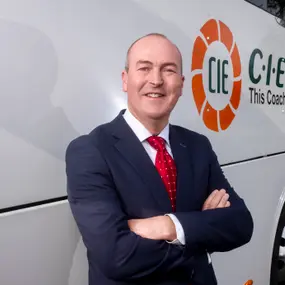
Managing Director, CIE Tours International
Stephen Cotter is managing director of CIE Tours International, the Irish government-owned tour operator that has brought visitors to Ireland since 1932. The company now carries more than 35,000 travelers a year from North America to Ireland, Scotland, Italy, Iceland, and Spain. He was named managing director in February 2024, after serving as interim managing director from October 2023. He oversees operations across the company’s offices in the U.S., Ireland, and the U.K.
Cotter grew up in Dundalk, County Louth, and got his first taste of business as a boy. He bought stock at Belfast auction rooms for his parents’ secondhand furniture shop. After college in Dundalk and a couple of years in Australia, he joined CIE Tours as a management accountant on March 5, 2001. Over 25 years he has served as financial controller, general manager and, from 2016 to 2024, chief operations officer. In those roleshe helped lead a strategic transformation of the business and its expansion beyond Irelandand Britain.
A CIMA-qualified accountant with an Executive MBA from Dublin City University, Cotter served as deputy chairman of the Irish Tourist Industry Confederation (ITIC) in 2015–16. He has made responsible tourism a priority. That includes the CIE Tours Sustainability Action Fund, which supports community projects such as the Burrenbeo Trust’s ReFarm initiative in the Burren.


