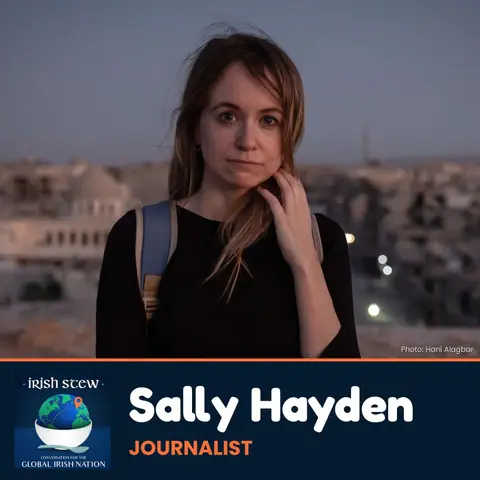
Journalist Sally Hayden finds love stories in wars and ruins

 Apple Podcasts

 Spotify

 YouTube

 Overcast

 Podcast Addict

 iHeartRadio

 PocketCasts

 Amazon Music

 Castro

 Castbox

 Podchaser

 TuneIn

 Deezer

 Spreaker

 RSS Feed
When Sally Hayden went on a book leave from The Irish Times, she needed a place to live and write. A friend offered a spare room…in Beirut.
But then the war escalated, and the Dublin-born journalist found she had a new job description. "Suddenly I became a war reporter," she says.
Her route to Beirut went through southern California where the young J-1 visa holder landed a summer job at the Santa Barbara Independent and struggled to get anyone to understand her accent when working the phones, a law degree though she’d never practice law, and a student grant that took her to Malawi at age 23.
A law firm interviewer saw her future before she did and told her, "You want to be a journalist. You don't want to be a lawyer."
She tells co-hosts Martin Nutty and John Lee of trials and travails of her freelance life, all the self-funded trips, the rides on the back of motorbikes, and the stories that never get published.
Her first book, My Fourth Time, We Drowned, began with a single Facebook message from a man locked in a Libyan detention center and went on to win the Orwell Prize. In her new book, This Is Also a Love Story, Sally finds unlikely tales of love, not always romantic, in nine countries in crisis, from a Ukrainian couple kept apart by war, to the "artificial families" that young survivors of the Rwandan genocide built for one another, to her evocative final chapter on the Drifting Post, used to send letters to the dead from Japan’s massive 2011 earthquake and tsunami.
She closes with a reading from the epilogue to This Is Also a Love Story, which includes this poignant takeaway:
“I know with confidence now that if you look for goodness, care, or kindness amid any crisis, you will find it. I know that local heroes are always present, too, even if their good deeds go unseen or unappreciated.”
LINKS
SALLY HAYDEN
HUMANGLE (Sally's Seamus Plug)
IRISH STEW LINKS
- Website Home Page
- BlueSky
- Mastodon
- Media Partner: IrishCentral
Mentioned in this episode (48) click to show or hide
The people, places and ideas Sally Hayden, Martin Nutty and John Lee talked about, part of the Irish Stew Global Irish Web.
People (3)
- Sally Hayden: Our guest; Irish journalist, photographer and author, based in Beirut
- Yuji Akagawa: Reads every letter left at the Drifting Post (raised by John)
- Jane Ferguson: War correspondent and past Irish Stew guest whose career Sally's echoes (raised by Martin)
Places (21)
- Africa: Half of Sally's beat, first reached on a student grant
- Middle East: The other half of her beat
- Lebanon: Sally's home and base since January 2024
- Europe: Where the people held in Libya were trying to reach
- Texas: Book tour stops in Austin and Houston
- Uganda: Her base from 2019, reporting for The Irish Times
- Rwanda: Where she reported on the 20th anniversary of the genocide
- Houston: Book tour stop
- London: About five years there, including a staff job at VICE News
- Beirut: Where Sally lives and works
- Malawi: Her first trip to Africa, a student-grant story on its first female president
- Drifting Post: Yuji Akagawa's post box for letters to the dead, the book's final chapter (raised by John)
- Nigeria: HumAngle's reporting on the crisis in the north
- Dublin: Where Sally grew up (raised by Martin)
- Sierra Leone: Her base after Uganda
- Libya: The detention center behind her first book
- Ukraine: A couple kept apart by war, in the book's first chapter (raised by John)
- Santa Barbara: Her J-1 summer
- Mediterranean Sea: The crossing the people held in Libya had tried to make
- Gaza: Palestinian students in Ireland on finding 'Irish parents'
- Japan: Setting of the book's final chapter (raised by John)
Organizations (17)
- The Irish Times: Sally's paper, from Africa to the Middle East
- HumAngle: Nigerian newsroom covering conflict; Sally's Seamus Plug
- U.S. Immigration and Customs Enforcement: Immigration controls came up on her US book tour
- Santa Barbara Independent: The paper she talked her way into on her J-1 summer
- University of Cambridge: Summer school on international humanitarian law
- British Red Cross: Ran that Cambridge summer school
- UCD Sutherland School of Law: Where she studied law; now an adjunct professor there
- Simon Cumbers Media Fund: The student grant that first sent her abroad to report
- VICE News: Her staff job in London
- An Post Irish Book Awards: My Fourth Time, We Drowned was Irish Book of the Year (raised by Martin)
- Michel Déon Prize: Another prize for My Fourth Time, We Drowned (raised by Martin)
- The Orwell Prize: Won by My Fourth Time, We Drowned (raised by Martin)
- Facebook: Where the first message from the Libyan detention center arrived
- Twitter (X): Where she posted the detainees' messages in 2018
- European Union: Complicit, her reporting found, in the abuses in Libya
- CNN: First outlet for her 2014 story on Rwanda's artificial families
- Boko Haram: Subject of a chapter Martin found eye-opening (raised by Martin)
Events (3)
- Rwandan genocide: Survivors who formed artificial families
- Russian invasion of Ukraine: Backdrop to the Ukraine chapter
- 2011 Tōhoku earthquake and tsunami: The disaster behind the Drifting Post (raised by John)
Music, film and books (3)
- This Is Also a Love Story: Sally's new book: love and kindness found in crisis (raised by Martin)
- My Fourth Time, We Drowned: Her first book, begun with a Facebook message from Libya
- No Ordinary Assignment: Jane Ferguson's memoir (Martin calls it "No Ordinary Correspondent") (raised by Martin)
Ideas and finds (1)
- J-1 visa: Her student summer in the US
Episode Details: Season 8, Episode 33; Total Episode Count: 174
00:00 - Introduction
01:32 - Book Tour Before the Midterms
06:14 - From Law to Journalism
13:13 - The Road to Beirut
18:02 - Freelancing Without a Net
22:02 - A Favor and a Challenge
22:50 - A Message from Libya
26:47 - Why a Book About Love
29:12 - Ukraine: Love Across Front Lines
33:54 - Rwanda's Artificial Families
39:23 - Japan and the Drifting Post
45:35 - A Reading from the Epilogue
47:20 - Seamus Plug
50:41 - John & Martin Recap
52:28 - Credits
Journalist Sally Hayden finds love stories in wars and ruins
Episode transcript · Released November 23, 2026
This transcript was generated with AI speech-to-text and given a light editorial pass, removing filler words, false starts and repeated words. It has not yet been independently verified against the full audio. The episode itself is the authoritative record.
Speakers: John Lee Martin Nutty Sally Hayden
Jump to chapter
# TIME CHAPTER
1 0:00 Introduction
2 1:32 Book Tour Before the Midterms
3 6:14 From Law to Journalism
4 13:13 The Road to Beirut
5 18:02 Freelancing Without a Net
6 22:02 A Favor and a Challenge
7 22:50 A Message from Libya
8 26:47 Why a Book About Love
9 29:12 Ukraine: Love Across Front Lines
10 33:54 Rwanda's Artificial Families
11 39:23 Japan and the Drifting Post
12 45:35 A Reading from the Epilogue
13 47:20 Seamus Plug
14 50:41 John & Martin Recap
15 52:28 Credits
0:00 Introduction
John Lee [0:00]
Before we begin, a quick ask. Every Wednesday, we send out a short newsletter featuring the week's episode and the stories behind it. Just sign up for it at irishstewpodcast.com.
Sally Hayden [0:14]
I'd be moving around on the back of motorbikes and, you know, living in a room in someone's home and just managing everything myself. It's a different experience, you know, when you have a different kind of relationship with the country you're in. And I think that that tends to be much more my experience, that it's somewhere that I would feel like I'm a bit more connected maybe with generally the life of people as it's being lived.
John Lee [0:40]
That's Sally Hayden, the Dublin-born journalist who reports for The Irish Times from Beirut. And I'm John Lee.
Martin Nutty
And I'm Martin Nutty. Welcome to another episode of Irish Stew. Our guest Sally Hayden's first book, My Fourth Time, We Drowned, won the Orwell Prize. Her new one, This Is Also a Love Story, finds love in the middle of war and displacement across nine different countries. We get into the book, but we also wanted to know how a law student from Dublin ends up becoming a war reporter. The road runs through a J-1 summer in Santa Barbara, California, a student grant to Malawi, and a Facebook message from a man locked in a Libyan detention center. Here's our conversation with Sally Hayden.
1:32 Book Tour Before the Midterms
Martin Nutty [1:32]
Sally, welcome to the Irish Stew Podcast.
Sally Hayden [1:37]
Thanks so much for having me on. It's an honor.
Martin Nutty [1:40]
Delighted to have you here. And I want to start here. I've been following you on Instagram and I saw you were traveling in the United States, where you were doing a book tour on your latest book, This Is Also a Love Story. I wonder what you found out, because that was just shortly prior to our midterm elections. I'm not sure how often you've traveled in the United States. I'd be interested in your impressions of what you discovered in the course of that, because it's not just about the book. I assume you're always kind of watching, seeing, kind of taking temperatures.
Sally Hayden [2:19]
Yeah, sure. So I traveled to a lot of places in October: Washington, D.C., Baltimore, Boston, Austin, Houston, L.A., and then Miami. And you're right, I met a lot of people. I mean, I was doing book events in all of those places. I also talked to quite a lot of journalism students and did talks in universities generally. And in terms of what I found out, people were very concerned. It was a stressful time for many people. There were a lot of people who were kind of actively campaigning and involved politically in various different ways. I also went to the No Kings protest in Houston just out of curiosity to see it, obviously as an observer. And yeah, I think generally a lot of people were really concerned. I had people in my events kind of standing up and asking questions and talking about ICE, ICE deportations. I met some people involved in, like, Catholics in Boston, who said that their parish people are just disappearing because they're being rounded up and detained or deported. It seemed like people were really upset about the immigration controls. And there were also a lot of people talking about the Middle East, which I guess is related to my work. I've been living in Lebanon for the past almost three years now. And I did have some people kind of say, you know, why don't you report on America? Why are you reporting on other places? And I kind of was thinking to myself, what's happening in the Middle East is an American story. I've been living in a country that's being bombed with American weapons. So I find that sometimes there could be a disconnect there that was a bit disconcerting for me. Yeah, but I don't know. That's a very short answer. I'm not so used to traveling in the US, honestly. It was my first time going there professionally, for professional reasons, I think. And I used it as an opportunity to hear from people as well and to have conversations, and I'm really grateful for that. I think, yeah, I couldn't say that I completely understand America after being there for a few weeks.
John Lee [4:29]
I've lived there all my life. I can't say I really understand it either, Sally. Your book seems to have this kind of a search for hope aspect to it, and love perhaps being the avenue where hope is discovered. But did you find anything hopeful in what happened here on the midterms? And I just want to mention one little image that stuck with me in the day after the midterms. It was James Talarico's victory speech. And I wonder if you happened to see a picture or a video from it, and the sign that he had on his podium, "Love thy neighbor."
Sally Hayden [5:05]
I actually didn't see it, but I will say that I was in Texas, like I said, in both Austin and Houston. And I met so many people who basically had that philosophy. I did a talk, for example, in Baylor Medical School and was talking to medical students and doctors, many of whom are involved in treating people who have been through migration journeys and various other things. And yeah, I think that maybe from outside people have a view of Texas. There's a particular view of Texas that when I told other people I was going to Texas, they were like, oh, you know, it's a very harsh place. And I met so many people who were really very actively trying to take care of their community and do what they could to improve it. And it was interesting after meeting all of these people that, yeah, Texas did turn Democrat. I mean, I should say I'm a journalist, so I don't vocally support any political party or anything like that. But the philosophy of just taking care of each other as humans, I certainly witnessed that a lot.
6:14 From Law to Journalism
Martin Nutty [6:14]
I want to roll the clock back a little bit. You're from Dublin. Tell me about your people, your upbringing, what impact that had on the career that you chose to pursue.
Sally Hayden [6:30]
I mean, it's hard to say exactly what impact it had. I've never been anyone else, so I just know my own experience. But yeah, I'm Irish, from Dublin. I studied law actually at university, but I was always kind of interested particularly in the news. First I read a lot of fiction when I was young, and then I started reading nonfiction and kind of realized that the actual world can be as interesting as anything you read in a novel. And I became quite obsessed by watching the news when I was a teenager, 24-hour rolling news. And yeah, I think that when I went to university, I studied law, but I think that was related to learning how the world works, being interested in that. And I actually went on a J-1, which maybe people don't know what it is, like for students who can work in the US for a summer, Irish students. And I ended up, I wrote to the Santa Barbara Independent, that was where me and my friends were going, and said, can I intern with you? And I think they thought that a law student is maybe a bit more experienced than I was, because it's an undergraduate degree in Ireland. And they said, yeah, you can do like one day a week. So I ended up interning there when I was about 20. And that was a great experience for me, honestly, because they kept getting me to make phone calls, and no one at the time could understand my accent. I was calling the sheriff's office and trying to ask questions, and they'd be like, what are you saying? Send us an email. And the news editor would be like, no, call them again. And it really got me over. I think when you're starting out as a journalist, you're very shy. It seems weird to just call random people up and ask them questions, but that really got me over a lot of that fear, I think. So I graduated at a time when Ireland was in an economic crisis. In 2012, I finished my undergrad. In 2013, I finished my master's. And I ended up moving to London to find work as a journalist, and I was based there for about five years. And then I went to Uganda in 2019 and basically kind of became The Irish Times Africa correspondent, kind of slightly unofficially, because I was freelance. And I was based there and then in Sierra Leone, and then I went back to Ireland when my first book came out in 2022. And then I've been in Lebanon since January 2024, reporting on this region but also still covering various topics in Africa, and in Asia I was in as well last year.
Martin Nutty [9:04]
So you went into law. Now, I can imagine Mammy and Daddy might be delighted to see their daughter go into law, but you chose not to practice, as I understand it, and then moved into journalism. What was your plan, I suppose, when you decided to pursue the law? What did you want to get out of that educational experience, and were you looking down the line to kind of work on a more humanitarian front?
Sally Hayden [9:32]
Yeah, I mean, I was only, I guess, 18 when I decided, which, who knows why 18-year-olds decide anything. But I think that I was interested in law. I was always kind of one of these kids that ask questions, why, why, why, like annoying your parents just asking why about everything. And I think that I thought law would be an interesting way of understanding more of that why. How does a society work? What is the function of it? And I don't regret that. I think that law really teaches you to think in a very logical way that is quite helpful sometimes in journalism, and to analyze huge amounts of information quite quickly. And yeah, that was helpful for me, but I don't know that I wanted to fit into, like, I also found law in Ireland to be, I'm sure many people would argue with this, but it could be quite elitist. And a lot of people had families who were lawyers, which I didn't, or family law firms. Sometimes it could also feel a bit to me like playing a game that I didn't necessarily feel comfortable with. Game maybe is the wrong word, but also that it could exist at a remove from the general public, and I felt like that maybe wasn't what I wanted to do in the longer term. So I still went for law job interviews and stuff. I tried out for the internships in corporate law firms, and the interviewers, which I have learned, interviewers, they do actually sometimes know what they're talking about. Like, if you don't get a job, it can be that they realize you wouldn't appreciate that job. And I didn't get any of these commercial law positions. And one interviewer told me straight out, you want to be a journalist. You don't want to be a lawyer. And I was like, no, no, I want to be a lawyer. I think I ended up talking about, I was doing an elective in Middle East politics at the time, so I talked about it for basically the entire interview. And at the end, they were like, you know, this isn't the right job for you. So actually, now I do think they were right. But at the time, I was like, what's wrong with me?
John Lee [11:42]
Sally, we've had so many guests where what they took in college had very little to do with where they ended up. But we often hear, I learned something valuable in that degree. We've had accountants that went on to lead rock bands, and they knew how to run the band business. So you never know where these things are.
Sally Hayden [11:59]
You know what I would say? Because now I'm actually an adjunct professor at UCD Law School. A lot of my reporting has involved the law. So not on purpose, but just as I've ended up reporting, I report a lot on crisis situations, wars or dictatorships or various other situations, human rights abuses, and my reporting has ended up being used in legal challenges. In my first book, for example, My Fourth Time, We Drowned, there's whole sections on legal cases and legal challenges. And now when I go in to talk to law students, I talk about journalism and law and what are the links between them. And even two years ago, I ended up doing a summer school in Cambridge University with the British Red Cross, which was about international humanitarian law, because a lot of the time I'll be reporting on sites that could be potential war crimes, and understanding what the laws are is very important. So yeah, there actually is a big connection, but it did take me a while of being a journalist to realize that that link is there. And now I've kind of come back around and I talk a lot about the links between the two. But for a long time, they felt very separate.
13:13 The Road to Beirut
Martin Nutty [13:13]
If you think about it, in journalistic zones, a lot of times what journalists do end up reporting on is violations of the law in one way or the other. So I can imagine that would really stand to you. But the choice, your beat, is Africa and the Middle East. When did that decision happen, and why? Why those two massive regions?
Sally Hayden [13:39]
Yeah, I mean, it wasn't totally a decision. And I honestly wouldn't say I'm an expert on, like, how can you be an expert on either? But I have ended up reporting a lot in both regions. So when I graduated, I got a, it's called a Simon Cumbers Media Fund. At the time, there was a student award, and you entered and you could get a grant to go and report somewhere. And I was basically just looking at the requirements of the grant. They wanted a story that fit into certain different themes, and one was gender equality. I was still a student. I was just kind of googling around, seeing what could be a good story, and I saw that Malawi, the country in southern Africa, had just got its first female president. So I was like, oh, that could be an interesting story. Go to Malawi and see what's the reaction to having a first female president. Has it changed anything? So I pitched that, and I didn't expect to win it at all, and I did win it. This was when I was 23, just graduating, and I got a grant, but I also got mentoring from The Irish Times. So that was the first time that I worked for them. And I ended up just going out to Malawi on my own, and I did what has ended up being kind of the way that I work. You get some money, hopefully. Sometimes you fund yourself. Just go somewhere, live as cheap as you possibly can, spend as much time as you can meeting as many people as possible. And that first trip, in the end, I wrote two stories, and I was there about six weeks. You don't have time to do that when you're a professional, proper journalist. But it was really beneficial to me, because I just met everybody that I possibly could and spent a lot of time. I'd sit in the souvenir market, for example, with the guys selling souvenirs, and just get all the gossip of the day each day. And yeah, just really spent time learning what it's like to arrive somewhere that you didn't know much about before and figure out what's going on. So that was the first time I went to Africa. After that, I got another grant to go to Rwanda for the 20th anniversary of the genocide, and I did the same then. I spent about five or six weeks in 2014. And then I went back a few times, but I got a staff job in Vice News after that, in London, so I was doing desk reporting a lot of the time. But I was basically covering the whole world except for America, which was really nuts. But yeah, it kind of gave me a chance to expand my knowledge on lots of things. And then when I went freelance again in 2016, I went back to various countries in Africa a few times. And then in 2019, The Irish Times didn't have someone covering, you know, they had someone in South Africa, but they didn't have someone else who was a regular correspondent. And so I said, if I moved to Uganda, because I had been to Uganda and I had friends there, and I thought it was a nice country at the time, people speak English and the accreditation was pretty easy, at the time it was. So I said, if I move there, can I have regular work from you? And they said, yeah. So that was why I moved to Uganda. Then Sierra Leone, I went while I was reporting my book, and I just ended up staying there for a year or a year and a half, because it was COVID time and it was very complicated to move between countries. And then I went back to Ireland when my first book came out. And then I had a friend in Beirut. I had gone to Lebanon to report my second book, and I had a friend there, and I wanted to leave Ireland. I was on book leave, writing the second book. I just wanted to be somewhere else. And he had a spare room, actually the room that I'm in right now. And he said, do I want to come and just stay there? And I said, yeah, why not? And so I moved to Lebanon, and then the war escalated. When I went back to reporting again, the war here escalated, and suddenly I became a war reporter and started covering it for The Irish Times and for others as well. And I would never say that I'm an expert on, you know, Africa is a massive continent, and the region that I'm in now, there's so much diversity. I'm not an expert. I don't even feel like an expert on Lebanon, but I just try to do the best I can, depending on the story I'm reporting at the time.
18:02 Freelancing Without a Net
Martin Nutty [18:02]
I find that the most knowledgeable people that I encounter will say stuff exactly like what you said. As you learn more, you realize essentially how little you know. And it's humbling, and that's, in my view, a good thing. Your story reminds me a little of another guest that we had on here, Jane Ferguson, who wrote a book called No Ordinary Correspondent, I believe is the title. And your story really tracks her experience in a way. She made her career in the Middle East also, hybrid experiences from freelance to employed, but she wanted to cover the serious stories, and had a lot of difficulty getting support in terms of employment and economics. Can you talk to the precarity of your economic situation? Because I'm guessing it's difficult to pursue the stories that really grab hold of you.
Sally Hayden [19:09]
It was interesting, actually, talking to students, journalism students in the US. I had kind of forgotten that people don't realize that part, how much of this career can be proactive and self-funded, basically, and self-directed. People will ask me things like, were you deployed here or there, or where are they going to send you next? And I'm like, nobody's sending me anywhere. I tend to be deciding where I go myself. Yeah, you don't necessarily have institutional backing. I will say that I've been on contract with The Irish Times since 2021, which I'm really grateful for, since late 2021, and they've been really good. It's been nice to have that kind of regular deal, even though technically I'm still freelance. But my first book, for example, I reported it from 2018, and I did that completely freelance. Generally you're working for free, or you're just gathering material, even self-funding. A lot of the trips I'd pay for myself and hope to make the money back, depending on what I could sell or what stories I could report. And it does mean that you end up living in a different way. And to be honest, I do think that it can make you a better journalist, because if you have a correspondent that flies in, and of course many of them do incredible work, really great work, but if they fly in and they stay in a nice hotel and they're going around with a producer and they have everything kind of taken care of, or a driver. I'd be moving around on the back of motorbikes and living in a room in someone's home and just managing everything myself. It's a different experience when you have a different kind of relationship with the country you're in. And I think that tends to be much more my experience, that it's somewhere that I would feel like I'm a bit more connected maybe with generally the life of people as it's being lived. But yeah, it's different. It also depends what type of journalism you're doing. I do print, generally, and photography, and if you're a TV station that has a daily deadline, you really need good internet, for example. I don't always have that, whereas sometimes TV crews need to stay in nice hotels to get good internet and to upload. But I also think maybe people don't realize how much of news is being supplied by freelancers who are working in very precarious conditions. That can include, of course, me, who has an Irish passport, so I'm lucky that I can get to move around. But many colleagues are from a country where traveling is very difficult because of passport privilege, or lack of it. And so they're actually taking great risks to report and reveal what's happening without being able to leave that country afterwards.
22:02 A Favor and a Challenge
John Lee [22:02]
A quick favor while we have you. If you're enjoying this conversation, please share it with a friend who loves great journalism. Word of mouth is still the best way a show like ours finds new listeners. And if you want more, we'll put a link in the show notes to all 15 of our journalism episodes, Sally's included, which brings us to a challenge. Two of those 15 episodes feature Pulitzer Prize winners. Name them both, and the first correct answer gets a copy of Sally's book, This Is Also a Love Story. Email your answer to irishstewpodcast@gmail.com. Once again, irishstewpodcast@gmail.com.
22:50 A Message from Libya
Martin Nutty [22:50]
You've mentioned your first book a few times, My Fourth Time, We Drowned, which came out in 2022, and that was a huge success. You won a variety of prizes: the Orwell Prize, An Post Irish Book of the Year, the Michel Déon Prize, the Baillie Gifford shortlist. So a huge reception for that book. We obviously want to focus on the love story book, but just tell us a little bit about the premise behind the book. I've read the opening pages, how that story started, because it just seemed like the thinnest of threads that led to, obviously, a very successful book and a very compelling story.
Sally Hayden [23:33]
Yeah, I will say, My Fourth Time, We Drowned is actually available in the US, but just as an ebook and audiobook. I think right now the print copies are out, but it's in a lot of libraries as well. It was published by Melville House in the US. So in 2018, in August, I got a Facebook message, and it said, "Hi, Sister Sally, we need your help. We're under bad condition in Libya prison. If you have time, I'll tell you all the story." And it came from a young man who had been locked up with hundreds of others in what he called a prison. It turned out to be a migrant detention center. And they had pretty much all tried to reach Europe by crossing the Mediterranean Sea and been caught and forced back and locked up then for months. And then a war broke out around them, and the guards who had locked them inside ran away. And at that point, they were then contacting me and saying, "We're in a desperate situation. Please, can you help us? We really need help." So I was sitting, at the time I was still in London in a sublet, and I was just looking at my phone like, can this be real? I don't know if this is real or not. And so I did lots of fact-checking first, and then I contacted NGOs to see could anyone help. I contacted UN agencies, and then I started posting the messages on Twitter, which, as people know, in 2018 was a slightly different thing to what it is now. But I started posting these messages. The threads went very quickly, what they call viral. It ended up getting more than a million views. And so I thought that this was going to lead to those people getting help. But actually what it led to was more and more people who were trapped in other detention centers contacting me and appealing for help. And these were people who had fled various different situations, wars, dictatorships, crushing poverty, and ended up in Libya trying to cross to Europe, but instead had just been trapped in this very abusive system of smugglers and detention and militias. And so that sent me off on years of investigation, and I gathered so much information. And in the end, I decided I should put it together and write a book, because I just felt like this wasn't understood and it wasn't being documented. I don't know, in the US it's slightly different, I know. But in Europe at the time, when people thought about migration and dangerous journeys, I think they were just thinking of the boats, what happens when you try and cross the sea. And actually, the story is much, much bigger than that. And also the complicity of Europe in terms of trying to stop people from reaching our territory. That was a big part of the story that I was documenting. And what got revealed, by me and by many others, was that crimes against humanity most likely were taking place against these people, and that the EU was culpable or complicit in it. So that's all documented in the book, if people want to read a much more lengthy and eloquent version. And it was also documenting the human stories of people caught up in that, which I felt was really important.
26:47 Why a Book About Love
John Lee [26:47]
That's a good lead into discussing This Is Also a Love Story. You've talked about some of the difficulties of a journalistic lifestyle. Just what you're talking about there hints at the kind of emotional demands on you to process what you're witnessing. You talk in the prologue, referring to the Gambia chapter to come, that we'll talk about, how you heard an account that sucked the air from your lungs, a visceral physical reaction. And you talk about how reportage can be cold and exacting. Journalism is the first draft of history, but it only offers fragments of a wider truth. What can go missing in the initial retelling is a much fuller tapestry of human behavior, interactions, and the connections that drive them. And it sounds like in This Is Also a Love Story, you have settled on the word love, the concept of love, to explore in an unexpected way throughout the book.
Sally Hayden [27:46]
Yeah, I mean, so the thesis of the book, if that's how I would describe it, is that love exists. Because I've reported on so many crises, different types, and I think that sometimes it can get lost that love exists in all of these situations. And I wanted to document the human experience of people living through them, but also to show how this is a theme in all of my reporting. Because of course we focus on the cruelty of humans and violence, and all of that is incredibly important, but I also see love every single day when I report. And so it's a collection of stories, nine different countries, nine different examples of seeing love. Some are family love, even love for community, romantic love as well. Initially, I was kind of having the idea that this would be a really happy book, that it could kind of restore faith in humanity, and I don't know that it is that. Our job as journalists and writers, nonfiction writers anyway, is to reflect the reality of the world. And so I didn't want to sugarcoat any of these experiences or these stories, but I did want to highlight that there is also another theme running through all of this. And my definition of love was quite broad, which maybe you'll judge, but I felt like I interpreted love also as kindness towards strangers. Basically, love towards humanity itself is how I described it. And so that was also something that I wanted to document.
29:12 Ukraine: Love Across Front Lines
John Lee [29:12]
Let's get right into the first of these stories, the first chapter, Ukraine. You're there at a very poignant moment of the year, in the run-up to Christmas. And one thing I was struck with was the kind of telling details that tell the story, that paint the picture, and that reflect back onto the people so well and their attitude and how they're approaching things. I'll just mention a few of them, and a few Irish details pop through here and there, too. The Veterano Pizza, where the soldiers gather in camaraderie. The cocktail Brothers in Arms, which is Irish whiskey, gin and rosemary. The fact that the voice of Mark Hamill is on the app that alerts you to the air raids, and it ends, when the air raid is over, with "The Force be with you." The Christmas tree made of spent artillery shells. The Pogues song "Fairytale of New York" filtering in the background. And the statue of Princess Olga wearing a bulletproof vest. It speaks a lot about how the Ukrainians are processing what's happening to them and how they are carrying on. How do you use the details to tell this story?
Sally Hayden [30:22]
Yeah, I will say that this was 2023, so I went there for Christmas. I was there both in the run-up to and then actually for Christmas, and at least a day or two afterwards. It was actually the first Christmas that they had celebrated on the 25th of December. Before that, they had kind of moved it to not be in coordination with the Russian Orthodox Church. And this was coming up to two years after the full-scale invasion, but obviously the war has just gone on and on and on, and so I don't know how this chapter would look if it was reported right now. But already at that time, people were really exhausted. And what I wanted to show was particularly romantic relationships, because in Ukraine, when the full-scale invasion happened in 2022, men of a certain age were forbidden from leaving the country, and I knew that this had caused so many difficult decisions and conversations. Should the rest of the family stay? Should they go? What happens to relationships? Many men volunteered in the early days. They didn't know that this was going to last so long, and others were conscripted later, or they kind of felt peer pressure to join, or they volunteered for other reasons. And so I ended up meeting a lot of women. My idea originally, I was like, maybe I could meet partners of people who are on the front lines. And I kind of put out feelers, and very quickly I got responses that there were lots of women who were willing to talk to me. Women also fight, but it's men more that fight, so it tended to be more women that were kind of experiencing this. And I met a lot of them. I think only two ended up with their stories directly in the chapter, but I talked to many, many more, and they all kind of influenced it. And yeah, I don't know if I want to say a learning experience, but I learned a lot. It was a type of chapter where I really was like, I want to let people tell their stories themselves, in terms of how they see it, and I don't want to put my idea of how I would like this chapter to go on top of their experience. And there were interesting things that came up. For example, one woman, Ludmila, I think she was called, was talking about her fears about the return to traditional gender roles, which she had been fighting against in her relationship. And others talked about various other things that I didn't really anticipate but seemed quite relevant. But they all also talked about love. They talked about their relationships and how they were maintaining them and what the struggles were, and what it's like being in a relationship with someone when you never know when you're going to see them. You are worried all the time about their safety. You can't communicate necessarily. And they were all like, when you get married, you don't predict that this will ever happen. And it had kind of reset the relationship. And the main couple that I profiled, Irina and Sergei, so I interviewed Irina. She was so kind and generous with her time, and she was really like, I'll tell you all about our relationship. She told me about meeting Sergei. He was handsome, with a mustache like Salvador Dalí, and she told me about how they fell in love. And she talked to me for so long, and I spent a lot of time with her. And then, very unexpectedly, Sergei actually got let out and got to come home for Christmas. And so I ended up meeting him as well, which was really amazing.
33:54 Rwanda's Artificial Families
Martin Nutty [33:54]
I'm not sure quite what I expected when I picked up the book. A lot of times around war conditions, we have fictionalized accounts of grand love stories and people's separation and coming back together, sometimes tragedy, sometimes not. But I was struck by the chapter that you did on Rwanda, specifically a different type of love that I hadn't even considered, where you talk about the formation of a different type of family group. And you, as I understand, reported on this story quite early on in your journalistic career. It was 20 years after the Rwandan genocide. So can you tell our listeners about that family-based love, or the creation of new family, and how that is a healing process?
Sally Hayden [34:58]
I first had the idea for the book in 2018, actually in February 2018, I remember when, but I ended up getting a bit distracted by my first published book and by the reporting for that. And then I came back to it in 2022, and at that point I was thinking, what will I put in this new book as chapters? And I remembered that in 2014, as I said, when I had just kind of graduated and become a journalist, I got this grant to go to Rwanda for the 20th anniversary of the genocide. And while I was there, I just tried to meet everybody I could, and I ended up coming across these, what they were called, artificial families. And it was these groups organized by a students' association that were all genocide survivors, some of whom had both parents killed in the Rwandan genocide. Some of them had one. They were all young people, I think at that point in their early 20s. And they had been set up, this also happened in secondary schools and in universities, and there'd be a group. So a mother and father would be appointed. They were all pretty much the same age, but they'd meet up with their so-called children, and the mother and father would be like, once a week or twice a week, have you done your homework, or does anyone have anything to report? Just giving them encouragement. One guy who was in a family told me at one point he tried to grow an afro, for example, and his so-called mother was like, do you not have money for a haircut? And just slipped him money, because she thought that he just couldn't afford a haircut and that's why his hair was getting long. And so I reported on this, actually, for CNN at the time in 2014. And then 10 years later, so in 2022, I decided that would be a nice chapter if they still exist. I had no idea, is that something that lasted longer, or was it just a student thing? And so I decided I'm going to go track them down. And my plan was to do that in 2024, the 30th anniversary of the genocide. At that point, which, I mean, is in the book, it's a bit of a tangent, but I actually realized I'm not allowed to go to Rwanda because of reporting I did on something completely separate. So I tried to get on a plane, and I was told I'm not allowed to board the plane, because the Rwandan authorities had said that. So I had to kind of figure out other ways to report this. And I ended up contacting people remotely, and I actually then managed to meet one person who was involved in one of the artificial families in person, in Europe. And yeah, it made me think a lot, actually, about what is a family. Is it just something that exists by chance, or can you create a family? And is there, not a replacement, of course you can never replace a family that has been killed, and of course in many ways you can never get over that tragedy, but are there other kinds of support networks that can be provided for people? And it's been quite interesting. That chapter seems to have provoked a good bit of discussion around this, and I've spoken to people, for example, Palestinian students who came from Gaza to Ireland on scholarships in the last few years. One of them told me, that's so interesting, because they were like, I have Irish parents now. There's Irish people who, not to replace your family, but to stand in sometimes, to give you support when that family unit is not able to be present for you.
Martin Nutty [38:34]
Yeah, I think that's a particularly hopeful idea, and maybe it'll encourage lots of people. Obviously in the Rwandan case, we have this devastation where sometimes you lost all your siblings and your parents, and you're isolated, and you need to recreate a support system, because that's what families generally provide, those that are biologically related. But there's nothing wrong, let's say you come out of a difficult family situation, there's nothing wrong with creating your own family. You might not call it that, but those support mechanisms. What I was fascinated by was the overt effort to create that. And I think the beauty of that really shone through to me in that particular chapter.
39:23 Japan and the Drifting Post
John Lee [39:23]
Sally, you end the book in a very different way, a kind of a more poetic, I think, finale, a kind of a mist of prayer reaching up to the heavens. It's in Japan, roughly about 13 years after the Great East Japan earthquake and also the resulting tsunami that came from that. And you're focused on a man named Mr. Akagawa, if I got that correct. And he is putting himself out there, and he's listening to everyone's stories, and it begins to be too much for him, and he creates this idea called the Drifting Post, where people would leave letters to their departed, and he would then, with their permission, catalog them in a library that people could read and share. And it just has a beautiful, very Japanese aesthetic to it, a Japanese philosophy, I believe. But when he moved to the Drifting Post, he said something that I think maybe you must go through yourself. He said, "The people who talked felt release, but I was tortured by listening." Is that something you've had to cope with in the kind of journalism you've plunged yourself into? Is this book a little bit of a catharsis for you?
Sally Hayden [40:46]
Yeah, I mean, it's a really interesting question. I think that this book in a way is, hopefully I'm not in it too much, but in a way it is my reflection as well on more than a decade of doing this type of work. Particularly the prologue and the epilogue, honestly, it took me so long to write them, like years, because it's difficult to sit back and think, what are my takeaways from witnessing all of this? Very often you don't really stop and think about that, for a lot of reasons, including that it would be very upsetting. And I think that as a journalist, you tend to feel, and it's interesting in terms of Yuji Akagawa, because he set up this Drifting Post where people write letters to people who have died, and he reads every single letter. So it's not that he stopped listening, but he's kind of found a way to have a process, to make it maybe a more communal experience, and feel like he's both listening but in a kind of organized way, if that makes sense. And maybe being a journalist is also slightly the same, because you tend to be listening to process the information, to put it in an article, or to inform other people. And so I think I've found various devices in terms of not just listening gratuitously to people's stories of terrible things that have happened. And I think there is a lot more discussion now about things like retraumatization as well, and journalists being more careful around that, but also to hopefully make it a bit more collaborative, in terms of asking people what do they want to achieve from talking, how do they position their story, what do they think is misunderstood about it. Questions like that, which hopefully make it presented in a fairer way. But I do think as journalists, the times that I've probably suffered the most from reporting are times when, for various reasons, stories just don't end up getting published. And so you'll do the reporting, you'll gather it, you'll listen to it all, you'll go through your transcripts and go through your photos, and then for whatever reason, it won't get published. And part of why I actually started writing books, I think, is that I do have a longer-form way to reference the whole scale of my reporting, rather than feeling like a lot of it is just kind of getting lost in my mind, if that makes sense. I do the same with photos. I now upload a lot of them to the wire, so that they're available to any media organization, because I just feel like you've witnessed these terrible things and you've documented them, and you want that to be available to as many people as possible. And that makes me feel like I'm doing my job, or my role. I do really believe in journalism. I also think everybody's entitled to criticize it, and they should. But I really believe in the value of journalism and the importance of having facts available, or in-depth reporting, hearing accounts from other places, building connections, building empathy, all of this. I think it's so valuable.
John Lee [43:50]
I think also ending on this note, where everything else was, you're reading all the other stories of war-torn places around the world, and there's kind of geopolitics playing in the back of your mind, and who's at fault, and what policy could have changed this, and what information at the right time, and who's to blame in all of this. This was a natural disaster. And these traumas, these tragedies, happen beyond the things we screw up. And in a way, it can happen to anybody, because life was peaceful in that area. The pine trees that you mentioned at one point grew tall over the centuries. Only one of them remains. But this kind of trauma can visit anyone, and it shows a way through it. So I thought it was a very appropriate ending on several levels.
Sally Hayden [44:39]
Yeah, thank you. And I think also I wanted to end on actually a chapter about grief. I just felt like, exactly, grief touches us all. And I felt like I can't write about love without writing about how you love people after they die, and how you continue to kind of hold them with you, if that's how you grieve. And for that reason, that was why I put it right at the end, because all of the chapters contain grief, but this one is directly about it. And me myself, I've lost various people close to me in recent years, and I think most people have. Once you start aging, you lose people close to you, and it's something that, again, we all as humans will, if we live long enough, deal with. And so I thought that you can't ignore grief. I can't speak for everyone, of course, but that chapter for me, in a way, I find it helpful myself to report it.
45:35 A Reading from the Epilogue
Martin Nutty [45:35]
Sally, would you indulge us with a reading from the book? I understand that you want to read something at the end of the book as we draw closer to the end of this episode.
Sally Hayden [45:45]
Yeah, so this is from the epilogue. "These days, I often struggle to find motivation. I find myself unable to comprehend the agony that is being caused in places from which I have reported, the damage carried out or endorsed by some of the world's most powerful countries. I speak to those directly affected and can give them no reassurance that anything would change if the broader public were better informed. I scroll through news updates in horror and worry that my own sense of morality has been affected. That, in part, this relentless assault is aimed at grinding us down and making everyone accept the unacceptable. But there are reasons to stay committed. I know with confidence now that if you look for goodness, care or kindness amid any crisis, you will find it. I know that local heroes are always present, too, even if their good deeds go unseen or unappreciated, and their actions only improve the situation on a micro level, as opposed to transforming it completely. I gathered this reportage partially as my atonement for more than a decade in the journalistic world, which can strip detail, remove agency and flatten emotion, in comparison to the real world, which is brimming with all of those things. But I also hope it stands as an entreaty to the reader to always remember that people exist at the center of geopolitics."
Martin Nutty [47:06]
That is probably the best way we can finish off talking about the book. I think it's powerful. I think it's a beautiful reflection. So thank you for that.
Sally Hayden [47:19]
Thank you.
47:20 Seamus Plug
Martin Nutty [47:20]
And so we are at that point, sadly, where we're going to say goodbye. But before we do so, we'd like to hear about your Seamus Plug.
Sally Hayden [47:31]
So earlier we were talking about the importance of local media. And I think generally, I'd just like to plug all local media. The journalism industry is in crisis right now. And if you can subscribe to any local media, give them support in any way you can. We need them. So wherever you are, I just think that would be my plug. There was one organization that is not in the US but that I wanted to mention in particular, HumAngle. humanglemedia.com is their website. And this is a Nigerian news organization that I spent time with in March. They invited me as kind of a visiting journalist, or fellow, and I spent time in their newsroom, and they're just doing really, really important work into what's happening, particularly in northern Nigeria and the ongoing crisis there. And I was actually there when the Iran war started, and then in Lebanon, the war began again. And of course it's so important that we follow the Middle East, but what's happening in Nigeria and the broader region doesn't get the attention that it should get. And I was so impressed by these Nigerian journalists who are really dedicating all of their time to covering this really well. And HumAngle emphasizes human because they want to tell human stories as well. So I do recommend that anyone check them out, and support local reporting, and support HumAngle as well.
Martin Nutty [48:57]
I know John and I would most definitely second that. Journalism isn't free. It's not necessarily guaranteed. And great journalism only comes as a result of the support of readers. I think in the internet world, where there's been an expectation at times that journalism will be free, that's probably led to a degradation of journalism. So if you find somebody good, somebody you're passionate about, some organization, be it a news reporting organization, absolutely put your money behind your reading habits. And so with that, I'd like to say thank you to Sally Hayden for spending some time with us from Beirut. We hope you're safe there. We didn't get a chance to talk about the latest news from Beirut, but I know you're actively reporting on that, and you can find Sally's reporting in The Irish Times. But do yourself a favor, get yourself a copy of This Is Also a Love Story. It's available in the United States. It's obviously available in Europe. There are brilliant vignettes, and we didn't even get to talk about Nigeria, which was in your plug. The chapter about Boko Haram was eye-opening to me. I only simply knew the name of that group without really any understanding of the geography of that place and what has happened. So lots of good stories in this excellent book. And so a big thank you for taking the time to sit with us.
Sally Hayden [50:36]
Thank you so much.
50:41 John & Martin Recap
John Lee [50:41]
And that was Sally Hayden.
Martin Nutty
So, John, what stayed with you?
John Lee
Well, Martin, Sally's another story of someone who traveled a long way from where they started, both geographically and professionally. And I was touched by the inspired way she ended her collection of unexpected love stories, with that misty, wistful, poetic evocation of Mr. Akagawa's Drifting Post.
Martin Nutty
For me, it was how often Sally chases a story with no clear path to getting paid for it. She'll fund the trip herself, get around on the back of motorbikes, and stay in rooms in people's homes, just to get closer to it.
John Lee
And just to remind you, This Is Also a Love Story is out now from Scribner in the US and 4th Estate in Ireland and the UK.
Martin Nutty
And you can follow Sally's reporting from Lebanon in The Irish Times, and take her advice from the end of the episode: support the journalists who cover your own community.
John Lee
And thanks to Sally Hayden once again for joining us from Beirut. Stay safe, Sally.
Martin Nutty [51:52]
Irish Stew thanks our media partner, IrishCentral.
John Lee
IrishCentral covers Ireland and the Irish around the world, with the news, the history, travel, culture and opinion.
Martin Nutty
And Sally made the case for backing the journalists who cover your community. For the Global Irish Nation, that includes IrishCentral, where a lot of us go to keep up with home.
John Lee
Find them at irishcentral.com.
Martin Nutty
Until next time, slán go fóill.
52:28 Credits
John Lee [52:28]
Irish Stew is produced by John Lee and Martin Nutty. Editing, mixing and mastering by Lochlainn Harte. Music on Irish Stew was composed and performed by Rosa Nutty, with Donal Bowens on drums and Cathal O'Riordan on bass and synthesizer. For more on Rosa Nutty's music, please visit rosanutty.bandcamp.com.
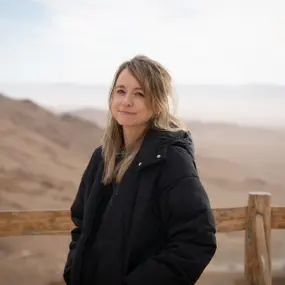
Journalist / Author / War Reporter
Sally Hayden is an award-winning journalist, photographer and author.
She has worked with VICE, VICE News, CNN International, the Financial Times Magazine, TIME, the Thomson Reuters Foundation, BBC, the Washington Post, the Irish Times, the Guardian, the New York Times, Magnum Photos, Channel 4 News, Foreign Policy, Al Jazeera, NBC News, Maclean’s, the Sunday Times, Newsweek, RTE, ELLE, Marie Claire, Die Zeit, Voice of America, the Independent, the Telegraph, Deutsche Welle, IRIN, the New Statesman, the New Internationalist, the National, the TLS, the Huffington Post and ITV News, and had stories and/or photojournalism republished on six continents by outlets including Pacific Standard, National Geographic, NPR, the Wall Street Journal, the Times of India, Euronews, the Christian Science Monitor, Sky News, Der Spiegel, the Observer, the Globe and Mail, ABC News, Forbes, the Economist and TeleSUR English, among many others.
HEFAT certified, Sally has reported from countries including Nigeria, Iraq, Syria, Sudan, France, Germany, Belgium, Burkina Faso, Ireland, the UK, Lebanon, Jordan, DR Congo, Panama, Cambodia, the Gambia, Liberia, Hungary, Luxembourg, Ukraine, Ghana, Rwanda, Malawi, Ethiopia, South Sudan, Madagascar, the US, Italy, Malta, Kenya, Uganda, Somalia, Niger, Tunisia, Palestine, Bangladesh and Sierra Leone. Her writing has been translated into at least nine languages and she has appeared as a TV and radio guest. Her work has also been exhibited in the Pompidou Centre in Paris; in German government offices in Berlin; and at EPIC, the Irish Emig… Read More