You Are What Your Mother Is: Andre Archimbaud's Unlikely Irish Story

 Apple Podcasts

 Spotify

 YouTube

 Overcast

 Podcast Addict

 iHeartRadio

 PocketCasts

 Amazon Music

 Castro

 Castbox

 Podchaser

 TuneIn

 Deezer

 Spreaker

 RSS Feed
Andre Archimbaud spent his life carrying three passports worth of heritage: a French surname, an Italian-American and Irish-American upbringing. While André's Irish identity may be masked by his last name, there is little doubt about the depth of that legacy. This episode, recorded at Ryan's Daughter on the Upper East Side, traces how Archimbaud came to understand that inheritance at a deeper level.
It started years earlier at a bar in Washington Heights, where a stranger, several drinks in, turned to him and said, "You are what your mother is," invoking a mitochondrial logic Archimbaud had never considered. Two weeks of digging into his maternal line turned up a great-grandfather from Sligo and a great-great-grandmother born in Dublin. From there, U2, a 1997 road trip through Killarney, and a growing engagement with Irish radio and Irish Twitter did the rest.
Archimbaud's other education came from his father, a man who rose from a cramped East Orange apartment to sit on the US Olympic Committee, and who taught his son to network simply by being watched. "It imprinted in me the sort of how to do this," Archimbaud says, a skill that now underwrites Clearly Now Media, the digital agency he launched after nearly two decades in paid search and social advertising.
Even the agency's name has an Irish thread: a Hothouse Flowers cover of "I Can See Clearly Now," framed on his living room wall, that his fiancé pointed to when he needed a name.
Archimbaud closes on a quieter note: two days alone on Inchydoney Beach in West Cork, sun and rain and a double rainbow, that stayed with him through a season of change.
LINKS
ANDRE ARCHIMBAUD
IRISH STEW LINKS
- Website Home Page
- Media Partner: IrishCentral
RYAN'S DAUGHTER
Episode Details: Season 8, Episode 25; Total Episode Count: 166
00:00 - Introduction
02:13 - Finding Irish Roots
05:02 - The French Family Name Story
08:16 - When Irish Identity Took Hold
13:03 - Deepening Ties To Ireland
18:16 - The Networking Superpower
24:48 - From Radio To Clearly Now Media
29:48 - Turning The Tables
34:08 - AI And Digital Marketing
38:40 - A West Cork Memory
42:00 - Seamus Plug
42:42 - Martin Recaps
44:34 - Credits
Irish Stew — André Archimbaud
Conversation for the Global Irish Nation
0:00 Introduction
Martin Nutty 0:02 Before we start, if you enjoy Irish Stew, hit follow or subscribe wherever you're listening. It takes two seconds and means every new episode lands in your feed. And if you've got a thought or a question, drop us a comment, we'd love to hear it. Go raibh maith agaibh go léir.
André Archimbaud 0:24 I went to Inchydoney Beach two days in a row. It genuinely was the closest thing to seeing the face of God, and I'm not religious at all. But I sat there and I was rained upon. There was wind, there was sun, clouds, all in like a 90-minute window each day. The second day, I had the benefit of a double rainbow over the other side of the peninsula. So it was very meaningful for me, having just started a series of life transitions around that time.
Martin Nutty 1:01 Welcome to Irish Stew, conversation for the global Irish nation, and I'm Martin Nutty. Our next guest is proof that Irish-American identity isn't inherited so much as chosen. André Archimbaud could have leaned Italian, that's how his father was actually raised. He could have leaned French, that's his family name. Instead, somewhere along the way, it was his Irish identity that took a more forceful hold. Professionally, André cut his teeth in traditional media, network newsrooms, radio production, before making the leap into online advertising more than 15 years ago. Today he's a digital media expert running paid campaigns for businesses across New York, and he's just gone out on his own with a new agency, Clearly Now Media. John and I get into all of that, but the heart of this conversation is identity, and how much less tidy it is than a simplistic, proud Irish-American bumper sticker. Let's get into it.
2:13 Finding Irish Roots
André Archimbaud 2:13 I was living up at 190th and Fort Washington, I ended up living there for about four years. And one particular Friday night, I didn't want to go home and decided to hang out at a place called Le Chéile, which is Irish for "together." So I amble in, I end up sitting next to this guy who's telling me a little bit of his story. At that point he would have been like two sheets to the wind, not quite three. But by the time he started to tell me that, we sort of circled the wagons on ancestry, history, my family, his own family, very Irish-American. And in fact, if I remember correctly, one of his parents was from Ireland, not uncommon to find here in New York at all. And so I said, I don't know what it is, but I've just always had this allure. And he turned to me very flatly and he said, "You are what your mother is." That sort of stopped me in my tracks, and I knew that there was some Irish heritage on my mother's side, didn't think there was any on my dad's side, and then proceeded over the next couple of days, couple of weeks, to do a little bit of very primary research on my mother's people. And lo and behold, it was closer than I had realized. It was my great-grandfather who was from Sligo, and that's on my mother's mother's side, and I still have a great relationship with that side of the family. And then on my mother's father's side, discovered that his grandmother, my grandfather's grandmother, was born in Dublin, raised in London around the time of the "famine," and then landed in the Northeast at some point in the 1890s.
John Lee 4:04 What's the mechanism that makes "you are what your mother is"?
André Archimbaud 4:08 This guy ended up telling me, by this time three sheets to the wind, saying there's a mitochondrial connection between human beings, and you are what your mother is. That was the sum total. And within two weeks, I realized I was more Irish than I had previously thought. Kind of simple as that. I wouldn't even say I put additional pieces together, it's just that a lot more started to make sense about my own leanings and things.
Martin Nutty 4:42 Yeah, I think that's interesting. As somebody that's fond of genealogy, I usually, when I start talking about it, encourage people away from focusing just on their last name.
John Lee 4:59 Right, in your case—
5:02 The French Family Name Story
Martin Nutty 5:02 That's clearly not particularly Irish. So tell us, is that pronounced Archambault, or Archimbaud?
André Archimbaud 5:08 Archimbaud.
Martin Nutty 5:09 So tell us about that.
André Archimbaud 5:10 So the funny thing is, both of my parents had French surnames. There was no French spoken in my house, pretty sure not in their houses at any level. I happen to be fairly adept at it because I had a fantastic high school teacher who taught me French, somebody I'm still friends with all these years later. But going back to that "you are what your mother is" line, that was one of the other realizations. I looked and I said, well, my mother's mother's people are Irish, a little bit of Scottish by way of Prince Edward Island, and then there's the thing about her father I already mentioned. But then I looked at my dad, and my dad was, despite the very French Archimbaud name, really raised Italian-American. My dad's mother and grandmother were in Jersey City and Hoboken. My dad was born in East Harlem, about 20 blocks from where we're sitting right now. And they lived in that little Italian enclave that's up by where Rao's is, what used to be a much larger Italian enclave after a lot of the Italians left lower Manhattan and headed uptown. But then when he was about four or five, they moved out to East Orange, New Jersey, and that's really where he was raised. My great-grandmother babysat Sinatra in 420 Monroe in Hoboken. My grandmother, they were, I think, two years apart in age. And so in that tenement, it's sort of the old-school line, everybody was looking after everybody else's kids. And so my great-grandmother would babysit. I knew this woman until I was about 12 or 13. On my mother's side, I knew my great-grandmother, whose mother was from Dublin, until I was 12 or 13 too, which is somewhat unique, I think. But on dad's side, he was raised Italian, or Italian-American anyway, even though there was a French name, and his grandfather was born in France. You know, might have heard a word or two, but culturally speaking, Italian-American on dad's side, Irish-American on mom's side, with French, Italian, and German on the one side, and then on the other side, on mom's side, Irish, Scottish, Celtic, and then Dutch and French. So, very much an Irish stew.
Martin Nutty 8:07 So we've established the fact that you are a good old-fashioned American mutt.
André Archimbaud 8:13 Sure, I think that's probably the best way to put it. I'm perfectly happy with that.
8:16 When Irish Identity Took Hold
Martin Nutty 8:16 But a chunk of you is obviously Irish. It's lurking in your DNA, so to speak. When did the Irish thing first rear its head?
André Archimbaud 8:30 You know, when I sit in an Italian restaurant, my Italian is showing. When I sit in an Irish pub like this, my Irish is showing. It's really two or threefold. I'm a kid who was raised in the 80s. The only thing I knew about my actual heritage at that point was that it was in there somewhere. And as we've progressed through the decades and learned more about some of that science and some of that data, and some of the less scientific aspects of it — but as a kid in the 80s, there were two things I knew that were from Ireland: the Troubles and U2. And U2 was my gateway drug. That may sound corny 40, over 50 years later from their inception, but it was the fact that — and I'm sort of tipping my hand on my family dynamic — there was a lot of internal strife there, and I think I may have projected some of that and aligned myself with some of it. I do not want to overstate or understate or misstate the connection, but I could appreciate the struggle that was going on. I didn't know much of the history yet, but then connecting the dots, very seriously connecting the dots, between landing in Ireland for the first time, February 1997, driving from Shannon down to Killarney on the N17 and just looking around. There were two things I took note of on that journey, that two-ish hour journey. One was I saw signs for HP, future home of HP, and another sign for another tech company. And if that wasn't a foreshadowing of things to come with Ireland being the doorstep of Europe for multinationals. The second thing I took note of was how absolutely stunning it was. I remember doing a scan of the lush rolling hills, the green, all the poetry that you hear. And I remember saying out loud, "I can understand why there's been so much bloodshed over this." It was a very visceral reaction, even getting choked up thinking about it now. For the next 10 days I spent driving around Ireland and soaking it up. And it's funny, I wouldn't have expected to get into this story, but it's a fun little nugget. Halfway on the flight from Boston, I was living in Boston at the time, I realized, "Holy smokes, I'm going to be driving on the other side of the road." We'd rented a car from Shannon to loop us around through the whole journey. And my dad, when I was a teenager, he was a pretty good baseball player, and one of the things he invested in me was a videotape set of one of the greatest hitters from the 70s and 80s, a guy named Rod Carew. The idea was you would sit and watch an hour of Rod Carew hitting from both sides of the plate, to left field, to right field, up the middle, bunting, whatever — the idea was to visualize, to see yourself doing it. So I spent a good 30, 45 minutes visualizing myself on the left side of the road, making the left turn into the left lane, and vice versa going to the far lane if I'm making a right turn, that kind of thing. But that was the first time — gosh, I wasn't even 25 yet — and I think having had that exposure at that age, it sparked a thing in me. And that trip, in a great many ways, was the foundation for the last 30 years of my affection for part of my mother's homeland, or multiple homelands.
13:03 Deepening Ties To Ireland
John Lee 13:03 So this foundational trip — it's so interesting, with all, you know, Italian's not a bad heritage to tap into, and French is pretty good too, but there's something about the Irish that seems to rise to the top. It's the strongest flavor in the stew, perhaps. What are some of the ways your Irish involvement has deepened over the years?
André Archimbaud 13:25 Yeah, so those first handful of trips — I made two trips, one in '97, one in '99, both about the same time, two weeks or so. And then I didn't go back until 2012, there was a 13-year gap, life happened in between. When I went back in 2012 — one of my favorite things to do in the world is to hire a car and drive around Ireland and listen to the radio. And in fact, on that first trip in '97, part of that cementing was that suddenly I'm able to tune into Gay Byrne. And in fairness, I was a burgeoning broadcaster, I was working for The Christian Science Monitor at the time, they had a radio network very similar to NPR, carried on public radio stations around the country. And I just fell in love with the way, quote unquote, the Irish do radio. Going back in 2012, there are a couple of interesting things. In 2007, quick sidebar, one of the founding fathers of Twitter is a friend of a friend, and he suggested I get on this platform. And unsurprisingly, the Irish do Twitter really, really well, they treat it like a virtual or digital pub in a great many ways, with all its warts all these years later, which we can or cannot get into. But when I went back in 2012, all of the radio presenters were reading out their Twitter handles, saying, "Hey, get in touch," they'd do a poll, they'd tweet us this, whatever. That was like candy to a baby for me, you want me to engage with you? One of my friends from this community, he's from Limerick, Danny Grace, said to me about 10 years ago, "They see you coming from a mile away, because you're this enthusiastic, earnest, genuine person trying to engage." I had somebody genuinely Irish on Twitter mistake me for being a local, they thought I lived in Dublin because I was so engaged with Irish Twitter, now 15 years ago. And it was sincere, they weren't putting me on and I wasn't putting anybody on, I was just engaging in the conversation. So those two things, Irish radio and Irish Twitter, cemented that for me. And then I had an idea, with my own background in music production, broadcast production, my own love of music — in 2013, 2014, just under the heading of "nothing ventured, nothing gained," I had this idea of developing a music management agency that would make it easier, particularly but not exclusively, for Irish acts to come over and play and ply their trade. And because of that connection through Irish Twitter, I pinged a handful of those presenters, a handful of artists I'd gotten connected with, and said, "Is this a business?" I'm coming at this from the outside looking in. And I had more than a few of them say, "Yeah, this is a business, and we want to play more in the States." That's before some of the challenges with immigration at the moment, but still. In the 12 years since I had this idea, I've come to realize there already was some of that existing. But that's what brought me to the IBO.
Martin Nutty 17:23 And just from a context point of view for maybe American listeners, Ireland is small, it only has 7 million people. New York City has 8 million people in it alone, and you've barely touched America. So that's why I think Irish artists want to tap into that, because it is the big market.
André Archimbaud 17:40 And so those two or three, four things commingling, I found a really cool community within the Irish Business Organization, Digital Irish, Irish Network, because there was a legal component to the immigration, getting a visa for somebody. I got involved with IABANY, the Irish American Bar Association of New York. I feel like we should do a shot for that. But I got involved with all of these just under the heading of, if you're going to be in a community, you've got to be in the community.
18:16 The Networking Superpower
John Lee 18:16 You've kind of danced around some of your career here, André, and let's get into your career this way, because you've been laying out some proof points for why I consider you one of the master networkers.
André Archimbaud 18:29 Thanks, John.
John Lee 18:30 And I think I knew you through Irish Twitter long before I met you, and I remember thinking, "Oh wait a minute—"
André Archimbaud 18:36 "You're that guy." Oh yeah, no, it's a big part of me joining the IBO.
John Lee 18:41 And just to mention, we've had quite a bit of networking-focused conversations, we've had Kingsley Aikens and Dr. Martin Russell, who run the Networking Institute.
André Archimbaud 18:51 Sure.
John Lee 18:52 And just the first two names of all the many people on our list, and many of them good networkers — Margaret Molloy and Jeffrey Hayzlett.
André Archimbaud 18:58 Sure.
John Lee 18:58 Of course, you know as well. Talk about that André superpower.
André Archimbaud 19:03 It's ironic that I'm on a podcast called Irish Stew and referencing, now twice, my father, which he would appreciate. One of the things worth pointing out is my dad was raised by a woman who loved to parade. So when we would come into the city when I was a little kid, we would go to the Thanksgiving Day Parade, St. Patrick's Day Parade, sometimes even the Easter Parade. My dad had no lick of Irish in him but wanted to support this thing, and as a recovering New Yorker, this was one of those things he could share, up to and including — I grew up in the 80s in suburban Dallas right after we left the tri-state area — somebody or somehow dad got a tape of one of the St. Patrick's Day parades from, call it '82 or '83. That tape ran on a loop from 1983 to 1989 before we moved back to the tri-state area. So giving a little bit of respect to that side of the story, he's the one who would bring us to these things. He's also the one who taught me how to network. My dad was born in — certainly not squalor by any stretch, and certainly not compared to what we see around the world — but East Harlem, New York and East Orange, New Jersey were not necessarily nice places to be born and raised in the 30s, 40s, 50s. Part of his story was that he navigated his way from a two, maybe three-room apartment in a quad house in East Orange to eventually being on the U.S. Olympic Committee, being part of Nancy Reagan's Just Say No task force, the Women's Sports Foundation, and things like that. And it was mostly by osmosis, if I'm honest, because I would see him — I traveled with him quite a bit until I went off to college — and would go to these events where the head of the Secret Service was there, the head of the FBI was there, because he was involved in law enforcement and the U.S. Olympic Committee. Watching him navigate that as a kid, sort of — is the word "osmosized"?
John Lee 21:34 Imprinted. It really did.
André Archimbaud 21:36 It imprinted in me the sort of how-to of this. And the frank fact of the matter is, within your own life there are different aspects of networks that exist that you can either lean into as needed, or just little pockets of your day-to-day life, personal and professional, that you can access. And I saw him do that masterfully over the years. I take nurturing and navigating relationships very seriously, especially in this day and age where there's so much virtual and digital, slash AI, that can interrupt that flow of communication and conversation. I'd much rather do this any day of the week than be stuck behind a computer. The core of the whole thing is that's what networking is: figuring out how you can help somebody else so that, either directly or indirectly, they can help you down the line.
Martin Nutty 22:42 Yeah, that aligns very closely with the advice we received from Kingsley Aikens when we had him on the podcast. He kind of referred to the fact that when people use the word "networking," some people find it almost a sleazy word, and he was making the point that it doesn't have to be that. It's not meant to be an attempt to extract information out of somebody else, it's more a "how can I help you" approach. But I'm wondering, what's your advice for people who are maybe hesitant to engage in a practice which I think we all, at some level, understand is incredibly valuable?
André Archimbaud 23:22 I think it's a matter of staying open and engaging. It's funny, my brother-in-law, my brother's husband — if I say the word "networking," I'd say half the time I see him wince, even though I've only seen him do it maybe five times in person, but it's not necessarily built into him the same way. What's imperative, I think, is to know your business, whatever it is you're doing, whatever pursuit it is, well enough to know how you can help someone. And that may even be through your own network, it's very rarely a one-to-one scenario. In fact, after we're done here, I'm going around the corner to meet with somebody I met through the Irish consulate who's in the construction world and commercial space, just to see how we might be able to help one another. She's just landed in a new role, and just in the last year and a half I've launched my own digital agency. So what does she need? How can I connect her to opportunities or people? And then she, in theory, is going to ask me similar or the same.
24:48 From Radio To Clearly Now Media
John Lee 24:48 Let's talk about Clearly Now Media, your agency. Give us a quick runway into that — what you had done in media before, because you had that production side of things you were talking about, and more of that sales side of things — what was that transition, and then the launch of this?
André Archimbaud 25:05 My career is cut into two uneven pieces. The first 10 years I spent predominantly in network newsrooms, like The Monitor, like NPR, like CBS, predominantly doing radio production, but I did some TV and film production as well. And then, barring some fun conversations involving baseball and film and some other things, I stayed in the media business that whole time and transitioned into media sales in 2004. My first job in media sales was selling airtime for CBS Radio, WCBS here in New York, and I was there for about two years. During that time, digital, from a commerce perspective, was starting to really take off. The early days of the internet were very different than they are today for a whole bunch of reasons no one has time to sit and listen to — you're on the wrong podcast if that's what you're looking for, a history of the internet. But by 2007 I landed at Yahoo, and from then it's been almost purely digital.
John Lee 26:20 And what does that mean, André?
André Archimbaud 26:21 Starting in 2010, I moved into a role where I was working with mostly local and regional clients here in the New York tri-state area. I had a couple of national and international clients over the years, but at the end of the day, what I've been doing for the last 16, 17, almost 19 years, is either establishing, enhancing, or expanding someone's digital footprint in some form or fashion. 80% of my business currently is running paid digital media — Google Ads campaigns, Meta ads campaigns, Reddit, TikTok, all of these platforms. And when you run ads on these platforms, I'd say eight out of ten times the businesses running those kinds of campaigns, through me or somebody else or even on their own, are looking for leads to come in the door and buy their product or service. So after spending 12 years with a division of the USA Today Network and then two years with a startup, until about a year and a half ago, I went out on my own and hung my own shingle. And even that, even the name Clearly Now Media, is rooted in a connection to Irish history. "History" is a stretch, but the day before I was born, the song "I Can See Clearly Now" came out by Johnny Nash. One of the first TV shows I watched when I went off to college — I'm sitting in a friend's dorm room, I didn't have a TV or cable, and I'm watching Saturday Night Live — "I Can See Clearly Now" had always been a touchstone for me as a song, just light, lively, nice. Going back to some of the family dynamic, it spoke to me in a way, and here I was off at college, away from home, away from a lot of that stuff, and here's this band playing on SNL, playing their cover version of "I Can See Clearly Now." And lo and behold, it's a band called the Hothouse Flowers out of Dublin. Depending on who you talk to, they were the heir apparent of U2, I didn't know that at the time, I just was excited to hear this amazing, soulful version of this song, modernized. And then, cut to almost 25 years later, connecting with one of the presenters on RTE Radio 1 who is the guitarist for Hothouse Flowers, and in fact he was one of the advisors who was like, "Yep, that's a business," when I was trying to do the music management idea. So sewing all of that up, two years or so ago, when I was trying to think of a brand name, I have the waveform of the Hothouse Flowers version of that song on like a six-foot by three-foot thing hanging over our couch. And my girlfriend, Caitlin, turned to me and she said, "You've got to call the thing Clearly Now Media."
Martin Nutty 29:39 Staring at you in the face all this time.
André Archimbaud 29:41 Exactly, pretty much. And even on the back of my business card is the waveform for the song.
29:48 Turning The Tables
John Lee 29:48 Let's bring in another aspect here. You're somebody with a radio background and a podcasting background of your own, you've had your own podcast, New York Standard, going on...
André Archimbaud 29:58 Over 14 years.
John Lee 30:02 That's a pretty good track record. You've done podcasts in the business setting for people you've worked for. And you've probably listened to more of our 170 or so episodes than almost anybody else.
André Archimbaud 30:19 You might be right, I haven't taken a poll of our friends and family.
John Lee 30:24 I think everybody misses a few now and then. Turn the tables — what have you found listening to our podcast, where do you think we can up our game, and where would you like to see it go?
André Archimbaud 30:35 It's funny, I've been impressed by the caliber of the guests you guys have gotten from the beginning.
John Lee 30:42 Today, no exception.
André Archimbaud 30:43 Sure, thank you, I appreciate that. But the caliber of the guests, the fact that you've taken it out on the road a handful of times, done some live shows — part of the reason I was drawn to digital marketing, advertising, media sales, is there's that old adage, I know you have a Philly contingency, would know JP Wanamaker and many other folks, based in Philly, he had a line that said, "I know 50% of my advertising is working, I just don't know which 50%." And in theory, if you look at traditional media, television, radio, print, billboards, there's no great way to dial in to know how well something is working other than, "Hey, the phone's ringing, we're fat and happy." With digital, you can quite literally see what keyword made something happen, what publisher, what outcome. Bringing that up to podcasts, there's a ton of data in there, I'd be curious to see some of that data to see if it can help direct subjects, guests, opportunities. I think you guys have done a great job, especially as relative novices, and I'm mustering all of my respect for that. When we were sitting down, I was looking at the gear, from my years of actual training in how to run a recording studio, a production studio, an audio studio — you needed a ton of stuff, and the little gearbox we're using here is astounding to achieve all of this. But I would go to the data, I would look to see where you're getting listenership from, what kinds of topics and subjects. I think video and some of the other things that make podcasting — some of my friends have been podcasting for 20 years, and it's a worthwhile story. When I got downsized at Yahoo in 2009, one of the guys I'd worked with at The Monitor and then at WNYC here in New York, Public Radio, I took him to dinner and said, "I'm trying to figure out a way back into that end of things." There was a particular show I wanted to be involved in, and he said, "That show is impenetrable between the host and the producers, no way. But we're playing around with this online thing." This was 2009, 16, 17 years ago, and he said, "If you can throw something together—" it took me three years to get something together, and the thing had already left the station, you know what I mean? So sort of an object lesson: if somebody who is, at that point, the head of programming for WNYC, is saying "put something together," put something together, don't sit on your laurels for three years.
Martin Nutty 33:55 A kind of "seize the day," if you will.
André Archimbaud 33:58 Yeah, and coming back to the technology, it exists, you don't even need the three or four pieces we have here to do what you're doing. You really don't.
34:08 AI And Digital Marketing
Martin Nutty 34:08 In terms of your expertise, this intersection with digital and businesses trying to get the word out — it strikes me that we're sitting in another unique time. I'll reflect on the dawn of the internet, late 90s, early 2000s, but now we're living in the age increasingly of AI. I'm somewhat skeptical on one level, because I see lots of people saying "AI, AI, AI"—
André Archimbaud 34:43 It's like AI, AIO. Yes.
John Lee 34:45 Or A1, according to our Secretary of Education.
Martin Nutty 34:49 But yes, dropping, sprinkling the word around like it's magically going to happen. As a business person, how does that reshape what you're going to do?
André Archimbaud 35:01 Oh, I'm feeling it already. Right around the time I launched Clearly Now Media, I had dinner and drinks with a friend and former colleague who is effectively doing what I'm doing now and has been for 10 years. He said, "A lot of the heavy lifting over the next 10 years is going to be done by AI" — by the time that 10 years is up, I'd love to revisit that conversation with him. It's strictly related to managing digital campaigns, so that's where it's impacted my day-to-day for the better, for the most part. Conversely, the challenge in my mind is that there are folks who think they can do some of this stuff on their own, and at the end of the day, you do need a certain amount of skill coming into it — if you're running a Google Ads campaign, you have to structure it a certain way, and in a bunch of different ways, to be able to have it run right, or Meta, or Reddit, or wherever. So in the day-to-day sense, that's very much how it's impacting my world, mostly for the better. I do think in other aspects of the creative fields — film, TV, other aspects of audio — it's a little concerning, there are films that have been made all AI. But I also want to demystify some of the AI conversation. AI is nothing new, what's new is having these large language models where you can plug and play, and there are ebbs and flows in that. At the end of the day, AI is anything with an algorithm, pure and simple, and that algorithm helps some sort of process improve in some way. What's happened in the last three to five years is how we're mining that data and doing with it what we are.
Martin Nutty 37:16 I think when we talk about this stuff, a lot of times it's very meta, very abstract in a way, and we're all, to some degree, fumbling around this 800-pound gorilla that's entered the room.
André Archimbaud 37:31 Sure.
Martin Nutty 37:31 And unfortunately, the light is off, and we're sitting in the dark trying to figure out exactly what's going on.
André Archimbaud 37:38 I have to admit, I just saw a thing in one of my trade publications, 20 or 30% use consumer AI for company or for pleasure. And in fact, one subset of that said — don't hold me to this number — that they're using a large language model, ChatGPT, Claude, for therapy. That is scary to me. Very scary to me.
Martin Nutty 38:12 It might speak to the issue of loneliness that people have. One of the things I've observed is that in a post-COVID world, people got used to being behind the screen, and many haven't reemerged. So I think you've made the case already for the importance of rubbing shoulders in the round rather than staring at somebody on a flat screen.
André Archimbaud 38:37 Totally, a thousand percent.
38:40 A West Cork Memory
John Lee 38:40 André, before we move to the Seamus plug, and we don't have to explain that to you, as you've listened to about 160 episodes, I think, but before we do, let's bring it back to Ireland and your visits there. Share with us a memory, an inspiration, something that stays with you, some evocation.
André Archimbaud 39:06 Oh gosh, how to pick. I've been spending a lot of time the last several years building an archive, I lost probably 10,000, 15,000 photos in a couple of different life changes and moves in the last seven or eight years. So anything I can get my hands on, I'm trying to catalog properly, with as close to the right date and as close to the right area, region, or town as I can. So some of this is fresh. But my standout is a particular day on my last trip over, January 2019, something I'm hoping to remedy very soon, sooner rather than later. I spent a few days in Leitrim with friends, then went into Dublin for a few days, saw some music on the Friday. When I booked my trip, I was planning on just doing Dublin Friday, Saturday, Sunday, and then leaving Monday, and I noticed my Airbnb was near Vicar Street, and I looked to see if anybody interesting was on that Monday night, and it was none other than Christy Moore. If you have a chance to see Christy Moore at Vicar Street, you'd take that chance. But the real focus of this was, after that, a friend of mine, Emma Reed, said, "If you're looking for peace, look for Ireland." Another friend of mine, Tilly Walsh, again this is that Irish Twitter community, said, "If you've only got a day or two and you want to go to Cork, you're going to want to go to Inchydoney Strand." And then I knew enough to know that De Barra's bar in Clonakilty is a must-stop, and has its own music history and legends. I went to Inchydoney Beach two days in a row, and it genuinely was the closest thing to seeing the face of God, and I'm not religious at all, but I sat there and I was rained upon, there was wind, there was sun, clouds, all in like a 90-minute window each day. The second day I had the benefit of a double rainbow over the other side of the peninsula. So it was very meaningful for me, having just started a series of life transitions around that time. That is the standout.
42:00 Seamus Plug
Martin Nutty 42:00 So we're now at that phase of the podcast where we introduce Mr. Seamus Plug, who has wandered into the room and is lurking, requesting that you plug.
André Archimbaud 42:12 My Seamus plug is: if anybody out there is looking for any sort of digital media assistance, whether it's your website, your paid or organic presence, up to and including map listings, Google Ads, Meta Ads, any and all of that — my links will be in the details of the show notes.
John Lee 42:35 Thank you, André.
André Archimbaud 42:36 Brilliant.
42:42 Martin Recaps
Martin Nutty 42:42 A big thank you to André. Both John and I were delighted to feature his story. He's a fixture in New York's Irish community, and if there's one thing this conversation makes clear, it's that André has mastered the art of connection. Whether it's a room full of strangers or building bridges with a client, he knows how to find a thread that ties people together. But connection isn't just about people — listening to him talk about those two days alone at Inchydoney Beach in West Cork, sun, rain, wind, and somehow a double rainbow through all of it, I'm reminded that we need to carve out those places too, the quiet, remote ones that feed the soul and connect us back to ourselves. And that's really what staying connected to Ireland is about, no matter where in the world you are. It's exactly what our media partner, Irish Central, does every day, keeping millions of us in the diaspora connected to home. They've been the go-to source for Irish news, history, culture, and travel since 2009. If it's Irish, it's on irishcentral.com, so check them out. Before we go, a big thank you to our friends at Ryan's Daughter on the Upper East Side of Manhattan, who were kind enough to host us for this conversation, it's a great spot to while away a few hours. This is Martin Nutty, and thank you for listening to Irish Stew, conversations for the global Irish nation.
44:34 Credits
John Lee 44:34 Irish Stew is produced by John Lee and Martin Nutty. Editing, mixing, and mastering by Lochlainn Harte. Music on Irish Stew was composed and performed by Rosa Nutty, with Donald Bowens on drums and Kyle O'Riordan on bass and synthesizer. For more on Rosa Nutty's music, please visit rosanutty.bandcamp.com.
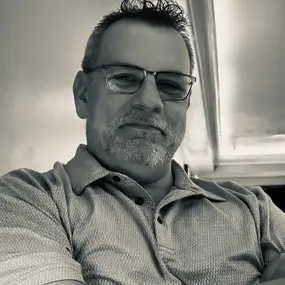
Founder & CEO
André Archimbaud is the Founder and CEO of Clearly Now Media, a New York-based media and marketing consultancy he launched in 2025 to help brands sharpen their digital advertising and event sponsorship strategy.
André's career spans nearly three decades of media. He started as a broadcast engineer and producer for The Christian Science Monitor's radio network, NPR, and CBS News, before moving into media sales in 2004. He spent twelve years as a senior account executive at ReachLocal, a division of the USA TODAY Network, and in 2017 co-founded Cara Entertainment Group, helping touring Irish musicians bring their acts to the United States. Clearly Now Media's name traces back to Johnny Nash's "I Can See Clearly Now," a touchstone song for André, released the day before he was born.
A graduate of Emerson College, André later served fifteen years as President of its NYC Alumni Chapter and sits on the founding board of MOSAIC. He's active with the Irish Business Organization and Digital Irish. While André was always aware of his mother's Sligo heritage, as an adult he uncovered Dublin roots too.