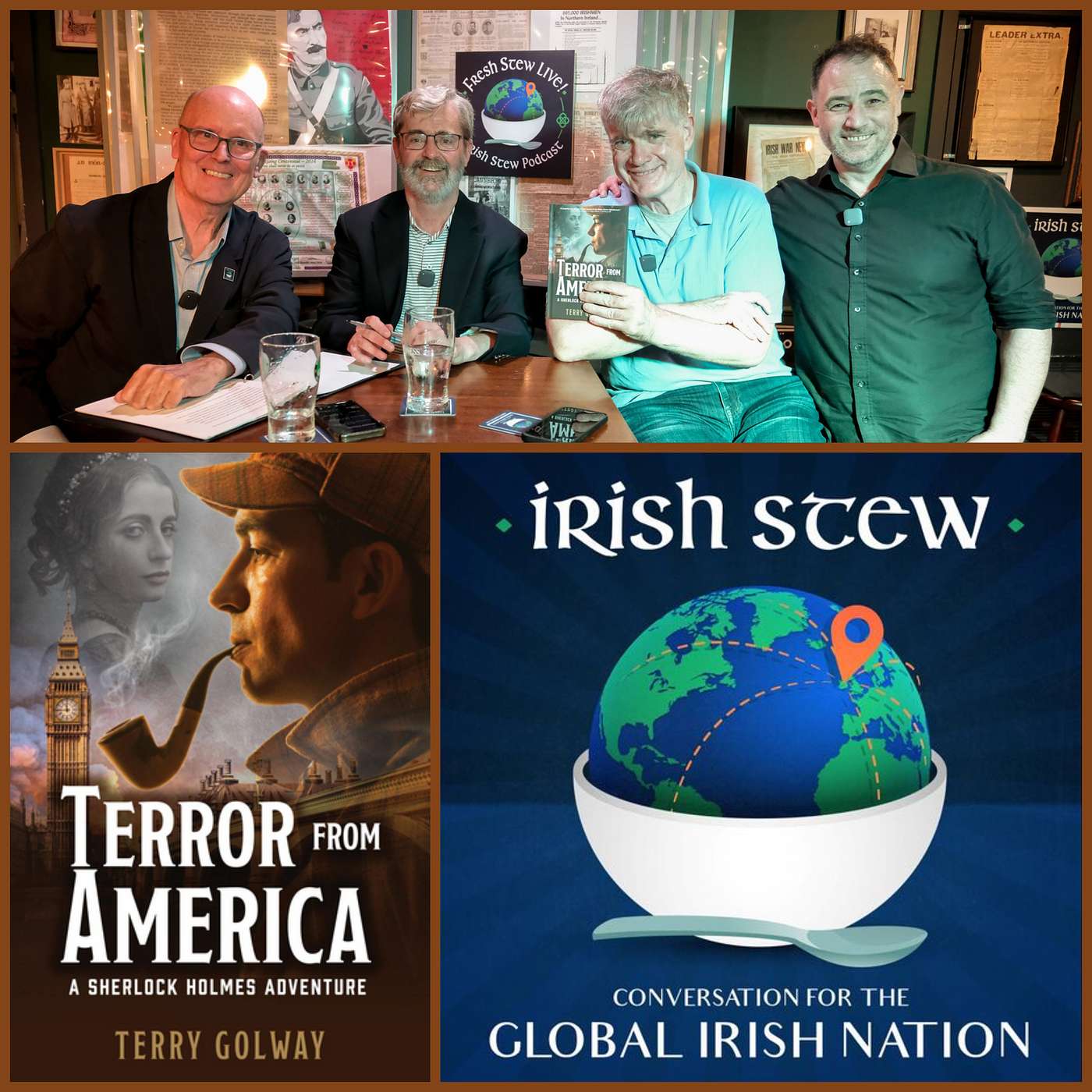
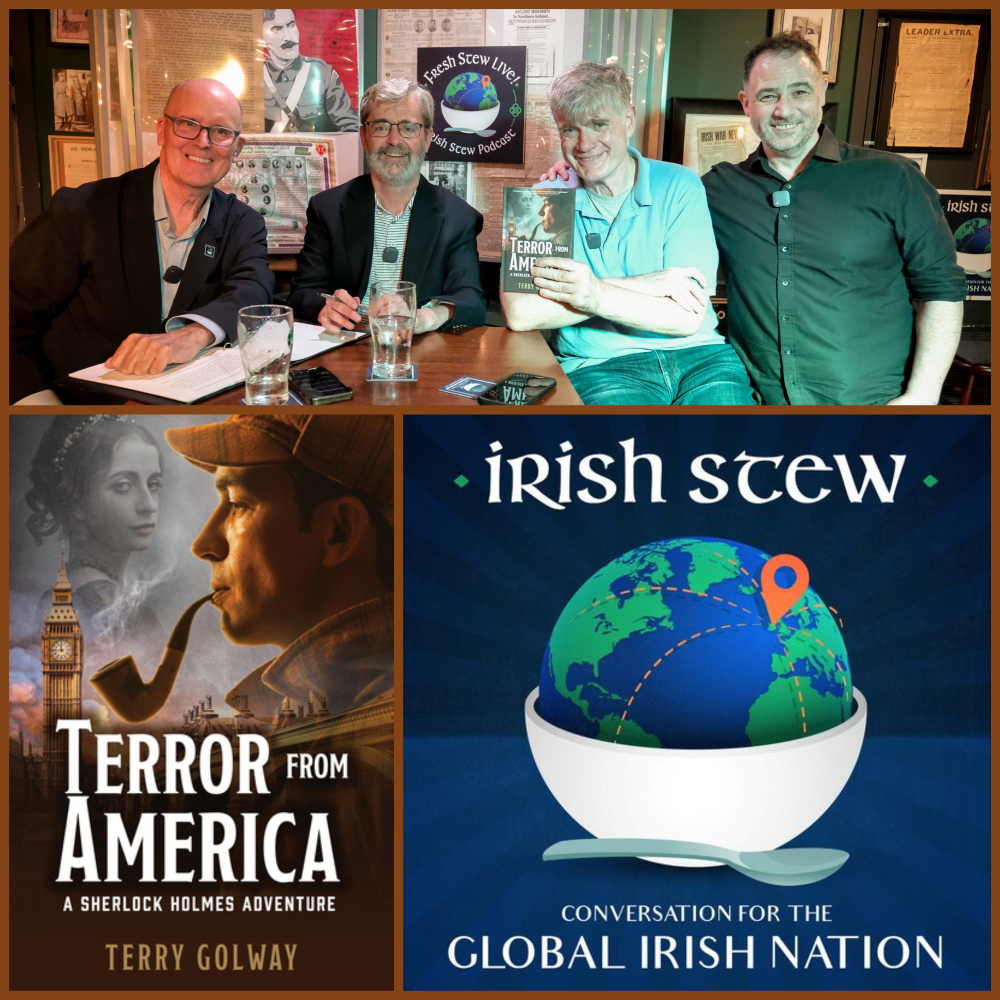
Transcript: Fresh Stew Live: Terry Golway in Conversation
IRISH STEW PODCAST
Fresh Stew Live: Terry Golway in Conversation
Ernie O’Malley’s, New York City • June 1, 2026
Featuring readings from Terror From America performed by Mick Mellamphy
Editorial Note
This transcript was generated with AI assistance and has been reviewed for accuracy and consistency with the audio recording. The audio remains the definitive version of this conversation. The transcript has been lightly edited for readability: false starts and crosstalk have been streamlined where they do not affect meaning, Irish language phrases have been standardized, and speaker attributions have been clarified. Readings from Terror From America, performed by Mick Mellamphy, appear in indented italic text.
Participants: Martin Nutty (host), John Lee (host), Terry Golway (guest), Mick Mellamphy (actor/producer)
Martin Introduces Terry Golway
[00:04:00]
Martin: So let’s start here. Terry Golway was born on Staten Island, the son of a New York City firefighter. He got his first job in the sports department of the Staten Island Advance on the day before he graduated from high school. That was 1973. He hasn’t stopped since. He spent two decades at the New York Observer — for those of you who remember that lovely pink paper — as a reporter, an editor, and a columnist. He sat on the editorial board of The New York Times. He has a PhD in American history from Rutgers, and he teaches at the College of Staten Island, the place where he went to college. He’s written more than a dozen books on the luminaries of New York and Irish American history: John Devoy, Tammany Hall, FDR, Al Smith — the first Catholic to run for president — and Fiorello La Guardia. Terry knows this city, and he knows what the Irish built in it. Tonight, though, we’re doing something totally different, which did perplex me when Terry first floated it. It’s a novel. It’s not history — but maybe it is. It’s set in New York in 1885, and in this book Sherlock Holmes has come to New York City. We’ll let him explain why as we go along. So, ladies and gentlemen — a big bualadh bos, which means clap your hands in Irish — for Terry Golway.
Terry’s First Sherlockian Moment
[00:06:00]
Martin: Terry introduced me to a new word: Sherlockian. What was your first Sherlockian moment?
Terry: It was a long time ago, in another world. I first encountered Sherlock Holmes by accident. I’d seen Basil Rathbone, but that’s not really Sherlock Holmes — sorry, Jeremy Brett. When I was in high school I had a magnificent English teacher — I would literally take any class he taught. At Monsignor Farrell High School on Staten Island, my teacher John Sonic taught a class in my senior year called the Fiction of A.C. Doyle. No idea who A.C. Doyle was. A.C. Doyle, of course, is the man who wrote Sherlock Holmes. I took the class, and here I am — I’ve written my own. It really starts in high school with a terrific teacher. And you know, that’s how a lot of things start.
How Did You Get to Be So Irish?
[00:08:00]
John: So Terry, how did you get to be so Irish?
Terry: Am I? My wife, who is sitting right here, is more Irish than I am, and so is my son — they’re both Irish citizens, so they obviously have the edge. Growing up on Staten Island, going to Catholic school in the 1960s, the Presentation nuns were wonderful teachers — despite me — and they were teaching us to be Americans. There was no reference to Irish history in my eight years in grammar school or my four years at Farrell. I was an American. I was a Cold War American. The hyphen scared a lot of people back then, or maybe we thought we’d moved past it. And frankly, it wasn’t until 1979, when the IRA killed Lord Mountbatten, that I found my way in. I was a reporter at the Staten Island Advance, looking for a byline. For me, Lord Mountbatten was a World War II hero. He fought on our side. Why did this happen? My parish priest, Father Morris Burke, I knew was from Ireland because he talked funny, so I went to ask him. Little did I know that Father Burke was the chaplain of Irish Noraid.
Martin: Oh.
John: Would you briefly explain what that is?
Terry: Noraid was an organisation that raised money for the families of prisoners in Northern Ireland during the conflict. I went to the rectory, sat down with a tape recorder, and said, ‘Father Burke, why did this happen? Give me a little history.’ I remember him starting off by saying, ‘Well, Terry, in the twelfth century…’ And I remember thinking: I don’t have enough tape. But Father Burke is the man who got me interested in the history of Ireland. I had zero interest before that. Zero. My grandfather was from County Donegal — he died when I was very young — and in school and in the family, we were Americans. My Irish journey actually ended up getting my parents interested in their own roots. That’s how it started.
From Political Science to Sports Writing
[00:10:00]
Martin: I do note that you graduated with a BA in political science. How did that fit with your first job writing sports stories at the Staten Island Advance? Was that part of the master plan?
Terry: There’s winners and there’s losers, and sometimes the winners are losers — but that’s another story for another time. Actually, some of the best political writers I read growing up had started out as sports writers. James Reston, I believe. So to me, some of the best political writing was done by sports writers. I’ve trashed that reputation entirely.
The Career Highlights That Set Up a Novel
[00:11:00]
John: Looking at your career, what are some of the highlights that set you up to write a novel?
Terry: As at least one person in this room would say, most of my journalism was fiction anyway. But I was really lucky, both at the Staten Island Advance and at the New York Observer, where I had editors who said, ‘You’re a halfway decent writer. You’ve got some possibilities. Go ahead and write.’ That doesn’t happen anymore. I had a succession of terrific editors, but I would be remiss not to mention my late, great friend and editor Peter Kaplan. Those of you who remember the New York Observer remember Peter Kaplan’s Observer. Fantastic editor. He gave me a couple of ideas for books, and it was he who said, ‘Go out and write.’ It doesn’t get any better than that. The Observer was owned by Arthur Carter, who died last December. Arthur had my back no matter what. I once wrote a story somewhat critical of David Dinkins when he was mayor. Dinkins called Arthur at seven in the morning on a Wednesday — that’s when the Observer came out — to complain about me. And Arthur said to the mayor, ‘Dave, just be glad Golway’s story wasn’t in the New York Times.’ How can you not like that? It was the Observer experience that really set me off.
Is Journalism the First Draft of History?
[00:13:00]
Martin: Your résumé is an exercise in confusion, at least for me — it ping-pongs back and forth between journalism and history. The old saw about journalism: is it the first rough draft of history? Are you a subscriber to that notion?
Terry: I am, all these years later. Seeing how journalism is practiced from the inside, you get an insight into how much we get wrong because we’re on a deadline and we have to get things done. It’s remarkable how much we do get right. But as a historian, I’ve learned to be very skeptical of what I read in newspapers — particularly John Devoy’s newspaper, may I add. Yes, journalism is the first draft of history. But it is just the first draft, and it takes trained historians to write it in a more rigorous way. Although — and hopefully nobody from Rutgers ever listens to this — some of the best writing of history I’ve read has been in novels. Peter Quinn’s Banished Children of Eve. If you were going to read a book about the draft riots, would you rather read a dry academic study, or would you rather read Peter Quinn? Read Peter Quinn.
John: There’s a quote later in the book that speaks to exactly this. A character called Maedhbh of Connacht says: ‘It’s an odd sensation to be a witness to a newsworthy event. To know the truth firsthand, and then to read about it in the newspapers, where facts fight a losing battle with sensation.’
Terry: Right. I had the Murdochian school of journalism in mind when I wrote that. I love being a journalist — I don’t think I could have succeeded at anything else — but some journalism I see practiced on a nightly basis on a certain news channel repulses me. When I gave Maedhbh that reflection, she’s witnessing a crime, she’s reading about it afterwards, and the newspapers have it all wrong. She knows the truth.
The State of Journalism Today
[00:15:00]
Martin: Let’s take you up to the present moment. Terry has launched a Substack — for those of you fond of Terry Golway and in the market for some really acerbic commentary, I recommend it strongly. What’s your take on this new and emerging single-shingle journalism?
Terry: It’s a world I don’t recognize, although I do participate in it now. I started a Substack almost on a dare from a friend of mine earlier this year. Some people make a lot of money through Substack — Paul Krugman, the former New York Times columnist, I think he’s doing very well. I refuse money because someday I’m going to wake up and say, ‘Do I play golf today or do I write a Substack?’ It’s going to be golf. But for the moment I’ve been writing about nineteen weeks’ worth of material, and I’ve found I enjoy it. Given the raw material out there these days, you can’t miss. I call my Substack Observer, which is a nod to the New York Observer — my favorite workplace ever — and also to my favorite columnist, Russell Baker, who wrote the Observer column for the New York Times for so long and won a Pulitzer Prize. He had a wry, acerbic, viewed-from-a-distance quality, and that’s what I try to do. But there may be a day when I just decide not to do it, because it’s no substitute for facts. There are no facts in my Substack — I literally make up conversations that the President of the United States might have. Maybe I didn’t make it up.
Martin: Sounded way, way too rational to be made up.
Terry: The search for truth and facts is still happening. Highly trained, professional journalists are working their hearts out to get the American people the facts. Whether they’re succeeding is not their fault. The question is whether there is a part of this country where facts are simply irrelevant. But never in my lifetime has journalism been so important as it is today, and yet, as you suggest, Martin, it’s struggling so badly. I feel deeply for my colleagues who have lost jobs, or who have jobs ill-suited to their tremendous talents. We need journalists now more than ever.
Reading: Revenge for Skibbereen
[00:19:00]
John: Let’s get into the premise of Terror From America with a reading from the opening chapter. At 221B Baker Street, George Jenkins, the Assistant Undersecretary for Crime and Police in Dublin, and Sherlock’s brother Mycroft, an adviser to Her Majesty’s government, plead for Sherlock’s help after a bombing near London Bridge kills the bombers, who are assumed to be New York Irish-American Fenians. Jenkins hands Sherlock a note he found in his office that morning, as Dr. Watson relates…
Mick Mellamphy: Holmes pulled a small piece of paper from the envelope, stared at it for several seconds, and then shared it with me. It consisted of a single phrase printed in large type of the sort one sees in the headlines of newspapers. The words were quite literally foreign to me. ‘Díoltas don Sciobírín.’ I shook my head and shrugged my shoulders, for I saw nothing familiar in this strange combination of letters.
‘It’s obviously in the Irish language,’ Holmes said, passing the note back to Jenkins. ‘I assume you have read it and translated it, Jenkins.’ Jenkins nodded. ‘It means “Revenge for Skibbereen.”’ Holmes lifted his bushy eyebrows and tilted his head. ‘Extraordinary,’ he muttered. ‘Extraordinary. I would hope any educated Englishman knows that Skibbereen is a town in Ireland, in County Cork, if memory serves. But why does it cry out for vengeance, and against whom? That will require some investigation.’
‘And now, Sherlock, you know why we are here,’ Mycroft said. ‘The Prime Minister has decided that these infernal American murder societies need to be broken up on their side of the Atlantic, not on ours, when it is often too late to take preemptive action. This latest provocation has put some steel in the grand old man’s spine.’ He paused for a moment and let out a deep sigh. ‘Perhaps he is having second thoughts about giving amnesty to all those blasted Fenians back in ’71. The worst of them went to New York and simply resumed their activities. I’m thinking, Jenkins, of two men whose names will be familiar to you: John Devoy, who fancies himself a journalist, and his one-time cellmate Jeremiah O’Donovan Rossa, who also publishes some sort of newspaper and openly recruits foolish young men for bombing missions. They are allowed to finance and plan their attacks on our public facilities with impunity, since it seems the American government has little interest in deterring them. Were it not for Mr. Gladstone, those two men would still be rotting in Millbank, or some other godforsaken place where they belong.’
Writing a Sherlock Holmes Novel: The Pressure of the Canon
[00:22:00]
John: For some people, saying ‘I’m going to write a Sherlock Holmes novel’ is like saying ‘I’m going to write a Shakespeare play.’ You’re up against a pretty discriminating audience of Sherlockians looking to decide whether to accept you into the canon. That’s an awesome responsibility.
Terry: I asked myself: to write, or not to write. And I decided to write. I felt competent to do it because of John Sonic, my Farrell high school teacher, and because I had read every story multiple times and loved them. I love the Jeremy Brett BBC series of the 1980s — he was a great Sherlock Holmes. So I wasn’t intimidated by the idea. But the Sherlockians — that was intimidating. I had one read the manuscript and said, ‘Just tell me if anything jumps out.’ He had a couple of good suggestions, but then he stopped me and said: ‘Several times, Sherlock wonders whether Professor Moriarty and Colonel Moran have Irish names and suggests we should think about that. There’s no way Sherlock Holmes would have said that in 1885 — he wouldn’t have said it until 1887.’ To which my response was: ‘You do know this is fiction. You do know he wasn’t real, right?’
Reading: Holmes Picks Up the Fiddle
[00:24:00]
John: The question is, how do we get the great detective to infiltrate New York’s Fenian underground? We find a clue later in that opening chapter…
Mick Mellamphy: ‘Now, if you will excuse me, my violin is calling even at this early hour. Some music may help sort out these problems.’ He retreated to the bedroom where he kept his Stradivarius. I settled into the armchair and returned to my newspapers, expecting to hear the familiar strains of one of Holmes’ favourite German composers. I was guessing Schumann, for it seemed like a Schumann moment — filled with darkness and mystery. Instead, I heard something quite different, something new in the Holmes repertoire. It was Londonderry Air. That familiar tune I had always considered little more than a vulgar dirge filled with the worst sort of Gaelic sentimentality. In Holmes’ sensitive hands, however, it became lovely and bittersweet, its high notes lamenting the loss of something well-loved. It was as though I was hearing it for the first time. I found myself strangely and unexpectedly moved.
Reading: Holmes Infiltrates the Fenians
[00:25:00]
John: We skip ahead in the story as Holmes writes back to Watson from New York on how he’s using his Irish fiddling skills to infiltrate the Fenians…
Mick Mellamphy: You will be delighted to learn that I am gainfully employed — a description few in Scotland Yard would associate with me. My fiddle has won me a spot with an itinerant group of buskers who travel the local shebeens and clubhouses in search of a few shillings for a night’s work. Among our presumably satisfied customers are the members of the Napper Tandy chapter of the infamous Clan na Gael organisation, which sponsors a Saturday night musical session for members and their guests. It is a clever tactic, Watson, for it gives the organisation the veneer of innocence. What could be the harm in providing the local proletariat with an occasional night of colour and remembrance in their otherwise dull and unforgiving lives? But there is a group of men separate and apart from the revellers, and their business clearly seems to be anything but musical in nature. I brought the evening to a close with my rendition of Londonderry Air, that bittersweet lament which unfailingly brings a tear to any Irishman worth his porter and potatoes. I could not help but notice that even the granite-faced Devoy appeared to be moved, though he shielded himself from scrutiny by lowering his head and making a study of the hall’s linoleum floor.
[Applause for Eileen McClain, who departed for her next engagement]
Martin: Hands up — how many people knew that melody was the Londonderry Air?
John: I was told not to say ‘Londonderry’ within this room.
Martin: It was composed a good while before Danny Boy, which most people in this room probably know better. But there’s a reference in what Mick was reading to John Devoy, and I think Devoy was a pretty seminal figure in your life, Terry.
Why John Devoy?
[00:28:00]
Martin: While you were still working as a journalist, you decided to write a biography of John Devoy, and he’s obviously a significant figure in this book as well. Tell me why you chose to tackle Devoy.
Terry: It’s another story about a person having an influence over somebody’s life without realizing it. I was at some Irish function — I think it was when President Robinson was on Ellis Island, around 1992 — and a woman named Angela Carter, who used to run Keshcarrigan Books on Chambers Street, cornered me. She peered at me over her glasses and said, ‘Terry, I have a book for you: John Devoy.’ And that was all she had to say. I knew the outlines already — born before the Famine, survived by moving to Dublin, tried to participate in the Fenian Rising, and he almost lived to see Al Smith nominated for president in 1928. Somebody born before the Famine who lived until 1928, who was involved in the Easter Rising, who was involved with Parnell in the 1880s. Through Devoy’s life you could tell the story of Ireland and Irish America from pre-Famine all the way to 1928. Angela’s the one to thank for that. It took me a number of years to execute because I was working full-time, and if you go to the National Library of Ireland and ask for the John Devoy papers, someone will say in a Brooklyn accent: ‘How much time have you got?’ I was there for almost a month. It was Devoy’s compelling personality, but also the span of his life, that told me this was a great story.
What Can Fiction Say That History Cannot?
[00:30:00]
Martin: So what do you get to say in a fictionalized account of Devoy’s life that you can’t say in a history book?
Terry: Everything. I make him out to be crabby on occasion — which I think he really was — and deeply unsentimental. There wasn’t a sentimental bone in John Devoy’s being. He doesn’t say that in his letters, but you can read between the lines. He’s totally practical: let’s get the job done. At the time of the novel, Devoy is trying to get Irish America behind Charles Parnell — a constitutional politician. Republican dogma held that you don’t work with constitutional politicians; the only answer is violence. But Devoy understands that by 1885 Irish America has reached a point where, if they can get the clergy, Tammany Hall, and the politicians behind home rule, something might actually happen. He’s set aside his oath to the Irish Republican Brotherhood in pursuit of something practical. Meanwhile, his former cellmate Jeremiah O’Donovan Rossa is after him in his newspaper, accusing him of heresy, because Rossa’s answer is to keep blowing things up. That tension between Rossa and Devoy is something I can explore in fiction in ways I couldn’t when I was confined to facts.
Peter Quinn in the Room: History Through the Novel
[00:33:00]
John: You build the story around a lot of real people and real history, and we’re fortunate that one of those characters from the 1880s is in the room tonight. Watson says he found a book called ‘The Lives of the Fenians’ by the eminent Irish writer Peter Quinn — he’s right back there. Sherlock says: ‘You miss the irony in my voice, Watson. Mr. Peter Quinn is obscure, save to connoisseurs of the greenish sort of purple prose. He is the low-rent Boswell for any number of Irish rebels.’ And with all that, he blurbed your book.
Terry: If you buy Peter enough Irish whiskey, you can get him to say anything.
John: As a historian who mostly dealt with facts until this book, did the historical framework give you a comfort zone to work from?
Terry: Oh, absolutely. I felt I was in my wheelhouse dealing with 1885 New York and Tammany. There’s a character in the book, Charles Francis Murphy, who in my non-fiction life is a major part of my book about Tammany Hall — one of the most neglected historical figures in New York. Everyone talks about Boss Tweed, but Tweed was boss of Tammany for maybe five years. Charlie Murphy was boss from 1902 to 1924, and he gave New York Al Smith and Robert Wagner. Not bad work. Tammany is a character in the book. So is Thomas Byrnes — the Sherlock Holmes of New York, as he was called in real life. I felt I knew that world.
Arthur Conan Doyle’s Irish Connection
[00:35:00]
Martin: You’ve arrogantly assumed the shape of Arthur Conan Doyle. Being a historian, I imagine you’ve probed his background — and those of you who know, Doyle is actually an Irish name. Is there any evidence he identified as Irish?
Terry: He was Jesuit educated, if that means anything.
Martin: So he was troubled.
Terry: There are two Holmes stories that touch on Ireland. The first is The Valley of Fear, which is essentially about the Molly Maguires in Pennsylvania — and the hero of that book is the turncoat, the spy who gives the Molly Maguires away. The second is one of the later stories, His Last Bow, set on the eve of World War I, where Holmes is disguised as an Irish American working with the Germans, spying on the British. Watson mentions having spent time in Chicago spying on the Fenians. So Doyle has actually given me the blueprint for a sequel. If this book meets any low expectations, I already know what’s next: Sherlock Holmes in America on the eve of World War I, as the Irish are planning the Easter Rising.
Randolph Churchill, Parnell, and the Dynamite Plot
[00:39:00]
Martin: One of the interesting aspects of this book is the political pressure being applied to Holmes. One of the characters is the father of Winston Churchill — Randolph Churchill. The plot device is that Churchill wants to tie Charles Parnell, who is trying to change things peacefully, to the dynamite plot. How much is fiction, how much fact?
Terry: It’s mostly fact — thoroughly factual, really. The British government tried on several occasions, through forged letters, to show that Parnell was in league with the dynamiters. He was in league with Devoy, right enough, but Devoy at that point was pursuing peace. Randolph Churchill may not have been involved to quite the extent I portray, but remember: in 1886, Churchill said of the Irish situation, ‘Ulster will fight and Ulster will be right,’ meaning the Irish Protestants would resist home rule. He was against it. In my telling, he’s manipulating Holmes — telling him, ‘I want you to find the link between these Irish dynamiters and Parnell.’ Holmes says, ‘What’s the evidence?’ Churchill says, ‘Find it.’
Martin: One of the things I love about historical fiction is that it’s an entry point into history. This book makes you ask exactly the questions I just asked: to what degree was Churchill involved in trying to discredit Parnell? And that question pushes you back to the real history. It sets out an interesting framework for a time that perhaps isn’t as well known as it should be — because on one level it’s not a violently dramatic period. It’s not 1916, and it’s not the rather pathetic Fenian rising. I can’t recommend this book strongly enough as an entry point to understanding the Irish American experience. And guess what? It’s damn entertaining.
Reading: Devoy Meets Parnell
[00:42:00]
John: Let’s bring Mick up to close out this portion of the program with a reading late in the novel, from the Diaries of John Devoy…
Mick Mellamphy: I told Parnell that I could move Irish America in his favour if we could agree on certain conditions, including his backing for Irish self-government. I noticed a brightening in his otherwise neutral gaze when I said Irish self-government. Such a wonderfully vague phrase, and one I chose deliberately to appeal to as many people as possible. Did I mean an independent republic? A form of home rule within the Empire? Something in between? I leave it to others to interpret as they see fit.
Parnell listened carefully. He was dressed as one would expect of a landed gentleman: a fine woollen jacket, vest and trousers, black leather boots well-shined, a dark silk tie, and spotless collar. His thin lips disappeared into a bushy beard. Appropriate enough for a man who gave away little with his mouth. I assured him I could deliver American support for his cause and, at the same time, kick aside extremists like Rossa and the other hotheads. The hair around Parnell’s lips parted long enough to form the phrase: ‘Very interesting.’ And that was the extent of it.
He came to America a year later and went on a cross-country tour to raise money for his party. I shared the stage with him for a rally at Madison Square Garden one night, as we raised thousands of dollars. I was delighted when this virtual Englishman told the audience: ‘The American people are now the arbiters of the Irish question.’ I am not particularly emotional, but I almost had tears in my eyes when I heard those words. That was exactly what we in New York wished to be: the arbiters of the Irish question.
[Applause]
Mick Mellamphy: All right, ladies and gents. Terry will be signing at the desk. Head outside, have a drink, and form a line. But first, a big bualadh bos once more for Martin Nutty, John Lee, and our wonderful guest, Terry Golway.
John: And for Mick Mellamphy, who not only performed the readings but helped us pull the whole evening together as our producer.
John & Martin Recap
[00:45:00]
John: Martin, a couple of takeaways from our conversation with Terry Golway. First, we saw that fiction is sometimes the most honest way into history. And second, that the Irishmen in the back rooms of New York’s shebeens in 1885 were not the crude caricatures the English newspapers made them out to be — as Sherlock Holmes sagely discerned. Formidable, not because of their capacity for mayhem, but because of the power they had over the production of memories. That line could have been written about this community today.
Martin: Couldn’t agree more. Now, the one thing you want to do is get yourself a copy of Terror From America. It’s available wherever you buy books — just go get it. And you can track down Terry’s Substack, called Observer: if you want the kind of commentary that the current moment demands and rarely gets, that’s the place. You’ll find links to both in our show notes.
John: And of course, thanks to our media partner IrishCentral, who spread the word on this episode and every episode we produce. If you want to stay connected to all things Irish, make sure you visit IrishCentral.com. That link is in the show notes too.
Martin: Thank you to Mick Mellamphy — performer, producer, and the man who kept the evening on schedule. And to Eileen McClain on fiddle, who opened and closed her portion of the night with exactly the right tone. And no Irish gathering would be complete without a raffle, so thank you to the Irish Rep for donating two tickets to any show in the next twelve months, to our guest Terry Golway, who gave a signed copy of Terror From America, and to Maura Clare of Smuggling Nun Potín, who contributed a bottle of her very finest.
John: A big thanks to Uileann piper Chris Byrne, who joined us for Fresh Stew Live and then wandered out to the front of the bar and led a great trad session. He gave people a good reason to hang around and enjoy the hospitality of Ernie O’Malley’s, and he gave us the sendoff we were hoping for.
Martin: And to the staff of Ernie O’Malley’s, who hosted the whole thing with genuine hospitality. That matters. Let’s say we made Monday night feel like a Monday night.
John: It was popping in there. Finally, we want to thank everybody who came out on their Monday evening to Fresh Stew Live on June 1st. Irish Stew is a show, but it’s also a gathering. You showed up and made it real.
Martin: We’re going to do this again in the Fall. Follow Irish Stew now, wherever you listen, and you’ll be first in line when we announce it.
John: And remember — we were sold out two weeks in advance. Until then, slán.
Credits
[00:47:00]
Martin: Irish Stew is produced by John Lee, Martin Nutty, and Bill Schultz. Editing, mixing, and mastering by Martin Nutty. Additional editing by Bill Schultz. Music on Irish Stew was composed and performed by Rosa Nutty, with Donal Bowens on drums, Cathal O’Riordan on bass and synthesizer. For more on Rosa Nutty’s music, please visit rosanutty.com.

OTD: Peggy Cummins - Actor (1925 - 2017)